
 The latest revised version of the DSM manual
DSM-5: ‘Diagnostic and Statistical Manual of Mental Disorders’
ICD-11: ‘International Classification of Diseases’
Both are medically accepted and widely used guides to diagnose developmental, mental, behavioural and learning conditions with all the criteria needed to be diagnosed clinically.
DSM-5, published by the APA (American Psychiatric Association), was written very much for US usage. Though it is now used occasionally in the likes of Europe.
ICD-11, published in 2019 and replaces the previous ICD-10, is maintained by the World Health Organisation (WHO) and is used internationally.
For the purposes of an Autism diagnosis, there is very little difference in the criteria listed in both manuals. So, I will reference the DSM-5 only from this point to avoid confusion.
It is also worth clarifying at this point – to those who are unaware – that Autism is a developmental disorder, not a mental, learning, or behavioural disorder (you would be surprised how often people get this wrong).
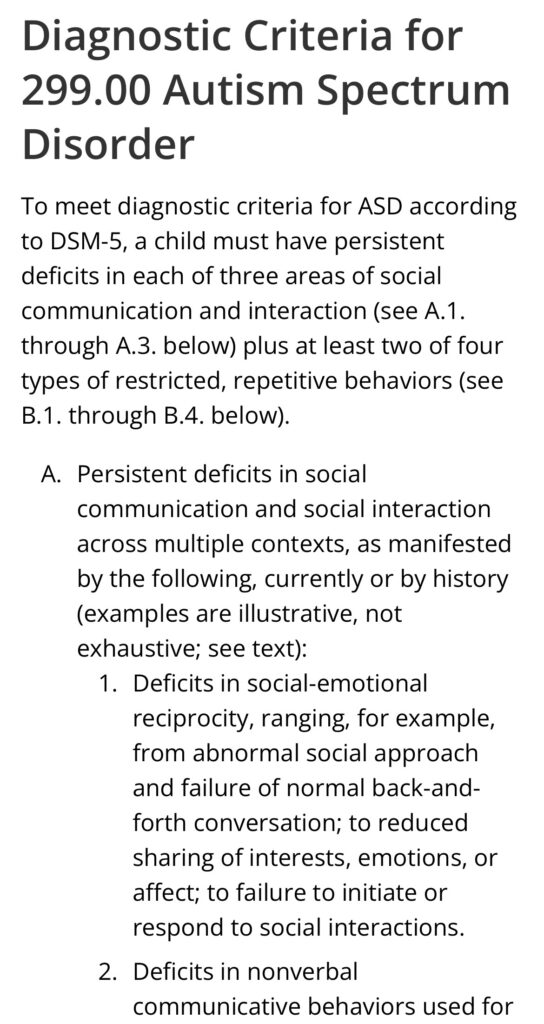 A snippet of the diagnostic criteria for autism, taken from the CDC website
I recommend that everyone wanting to learn more about autism read this, as it is medically factual and accurate in relation to the aspects which contribute towards a diagnosis. Also, it is important to note that not all points listed are needed to get a diagnosis. Being a spectrum, no two people will experience all the same developmental challenges that contribute towards being diagnosed.
Within this current DSM, Asperger’s Syndrome has been removed (this is what I was originally diagnosed with), along with PDD-NOS (Pervasive Developmental Disorder – Not Otherwise Specified). Both now fall under autism spectrum disorder. That in effect means that anyone previously diagnosed with either of these through the DSM now comes under the more encompassing Autism Spectrum. However, both Asperger’s and PDD-NOS remain listed in the current ICD – perhaps the biggest noticeable difference between the two publications. This means, for example, that Asperger’s is still a valid diagnosis in the UK, while it is not in the USA.
I won’t go too much into the contents because I’m sure that the guide itself will explain things better than I ever could here (though admittedly, it does lean heavily towards academic writing). However, the criteria are all based around deficits in social interactions and communication as well as repetitive and restricted patterns of behaviour.
Social interactions require several parts of the brain to work in unison, which is hard for autistic people compared with neurotypical people due to the differences in neuron connectivity between separate parts of the brain. On the other hand, autistic people MAY excel at things that require only a single part of the brain to operate, due to the task only needing short-range neurons that are found to be over-connected in individuals with autism.
Most people understand autism to be a single-layered disorder (probably based on prevalent stereotypes), when in actual fact it is highly varied. The autistic experience is not necessarily a shared one in terms of the social challenges that people on the spectrum face.
If you liked this article and would like to support my work, then please consider clicking on one of the buttons above to donate a little to either buy me a coffee or support my business initiative. Your generous support enables me to keep creating new and better content, as well as cover business development costs. Please only do this if you are financially able to do so, as these are challenging times for us all – Thank you!
Leave a Reply