
 The view along the Arno River
Did you know Florence is one of the best places you can visit as an autistic traveler (or any disabled traveler for that matter)? It has an abundance of history, culture, and art for all to enjoy – but what is it that sets it apart from other destinations in relation to disabled visitors? Well, the answer is simple – almost all attractions are completely free for anybody who is disabled and for their companion/carer. A little-known fact about Italy is that all state-run museums are free for disabled individuals plus one accompanying guest. Tuscany has gone one step further, and all Florentine civic museums are also free under the same circumstances.
I saved a whopping €160.50 across all the attractions I visited. Naturally, I did a lot more than the average tourist would as I ended up spending longer in Florence than I had originally intended. Hopefully, this illustrates the potential savings for the disabled community in this amazing city.
To receive the free entrance, proof is required in the form of a medical record, doctor’s note, or certification card. If you are unsure of what might constitute suitable proof, then I recommend speaking with your medical practice prior to your trip about what kind of evidence they can offer you. I personally had saved a copy of a Google translated sentence which read “I read online that anyone with a disability can enter for free”. This was so I wouldn’t have to verbally make it known to staff, as I often feel people in lines have a bad habit of standing too close behind me – and to avoid any miscommunications between English and Italian. It worked a treat, and the staff I dealt with had obviously been trained properly as they were all very polite, making sure I didn’t require any extra assistance mobility-wise and asking no unnecessary questions regarding my disability. A good job all round in my book!
 The Ponte Vecchio; a picturesque medieval arched bridge that is now lined with jewelry & souvenir shops
Of course, having to have written evidence, unfortunately, means that anyone who is a self-diagnosed autistic will not be able to benefit from the gratuitous entry. However, on my first day of touring alone, only 1 out of the 3 places I went specifically asked to see my proof. You might feel it’s a risk worth taking – but the outcome will depend on the staff member you will be dealing with.
It is also noteworthy that all the destinations I visited were self-guided. Tour guides are available, though I assume most if not all will be private and will incur an extra fee.
I will now be carrying my proof along with me for all future travels – as I have now been made aware of similar initiatives further afield that I could benefit from during my adventures.
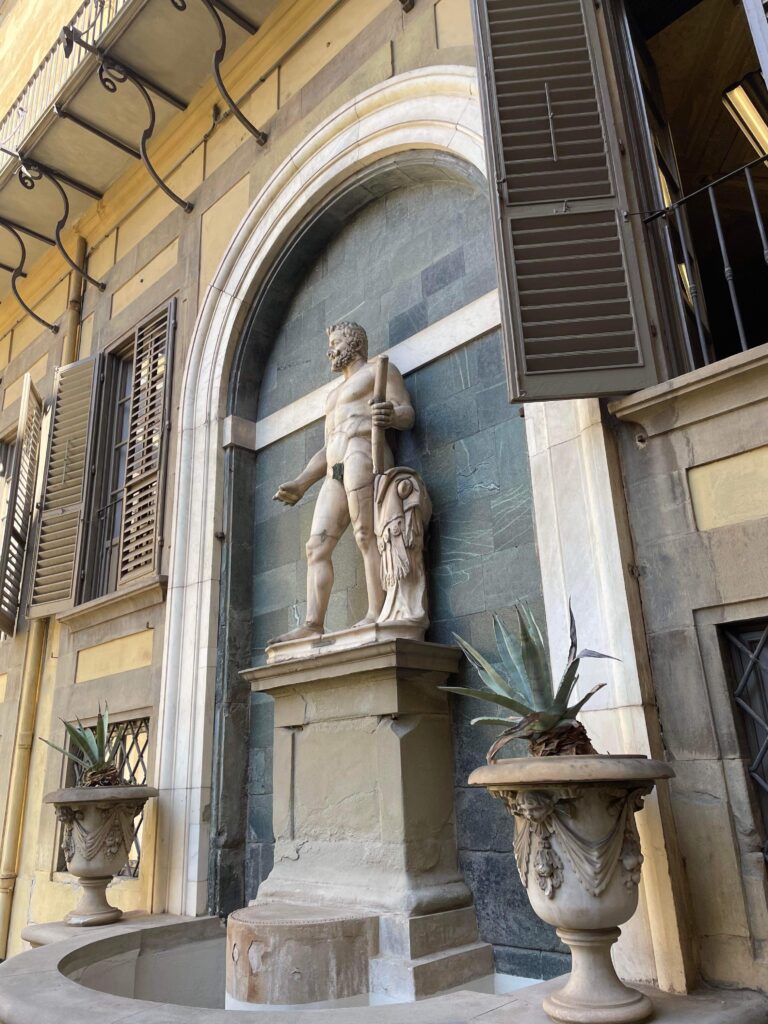
 The gorgeous courtyard at Palazzo Medici Riccardi
Day 1
I did a total of 3 free attractions on my first day of exploring the city’s many sights. It might not sound like a lot, but honestly, all 3 sites had a lot to offer, and my feet were aching by the time I finished the last one. So, I would say to anybody coming to Florence to also consider splitting the attractions across several days. This all depends on what you want to do while here, of course!
- Palazzo Medici Riccardi
First up was this prime palace located in the downtown area. Named after the highly influential family that later bought the grounds and expanded it into its current form, this stately place is one of extravagance.
Known specifically as the home of Cosimo the Elder and Lorenzo the Magnificent – the former of which placed the Medici family (of which he was a member) in effective rule of Florence during the height of his influence. The estate also played a huge role during the Italian Renaissance, boasting workshops for artists of the highest calibre.
 The interior of Palazzo Medici Riccardi is just one example of the outstanding artistic dedication that is present throughout the city
Now run by the state, this palatial property can be visited by the public. There is quite a lot to see and do inside, so give yourself plenty of time if you visit. There is a temporary exhibition hosted on the ground floor (it was paintings by Oscar Ghiglia during my visit), while the upper levels are where the museum is located – in which you get to visit the many rooms of the Medici family in all their splendour. There is also a mini-archaeological museum in the basement, which I didn’t feel had so much to offer apart from its fantastic collection of marble busts. The visit ends by crossing the family’s former garden. As well maintained as ever, this is also a lovely place to relax if you find that you might have overdone it during your visit or just need a breather before re-joining the busy streets.
- Basilica di San Lorenzo
Florence, like most major Italian cities, is filled with basilicas. Many of these can be visited for free by anyone. However, some of the grandest and most popular sites require tickets – and, all these are also free for disabled visitors!
This basilica is one of the largest located within the city limits. In fact, it acted as Florence’s cathedral for 300 years before being replaced by the current cathedral of Santa Maria del Fiore.
 Florence is full of religious sites in the center open to the general public
Brimming with religious arts and relics, there is a lot to cover during your visit. Indeed, the basilica is part of a complex consisting of 3 sites within the grounds. These are the basilica itself, the Medici Library, and the Medici Chapels.
Next to the main structure are 2 large cloisters – beautifully solemn in nature. These are both great spots to take a few minutes out if you need to.
Be sure to head to the basement during your time here too. That is where the San Lorenzo Treasure Museum is found, and houses many historical objects put on display for your viewing pleasure. This was originally a catacomb, and a couple of tombs can still be seen alongside the exhibits.
- Basilica di Santa Maria Novella
If you are arriving into Florence by train, then you can’t miss this one – it sits directly opposite the main station (and in fact the station owes its name to this basilica)!
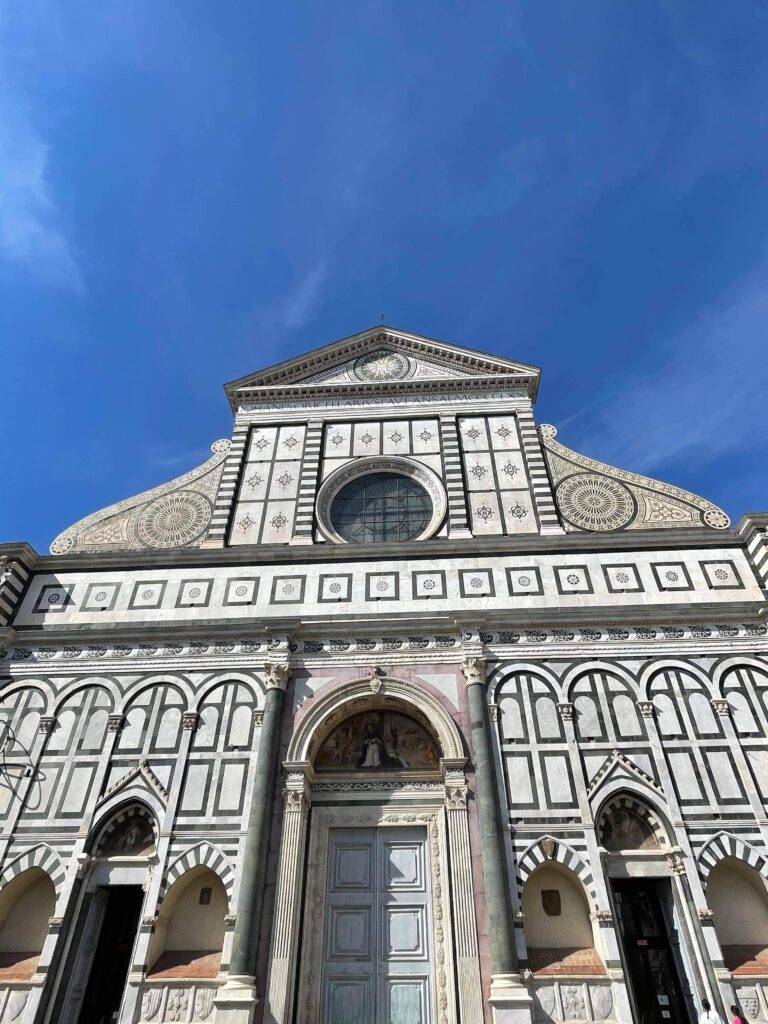 Basilica di Santa Maria Novella is a typical example of Italian Gothic-style architecture
Completed in 1420, it is the first of the great basilicas to find a home in Florence. First founded by the monks of the Dominican Order, the site has continually proven to be one of significant importance within the realms of both religion and artistry. As such, the vast gothic interior can almost be seen as an art gallery, and guests are free to explore all its expressive endeavours.
I was interested to learn that the walls of the church were initially adorned in frescoes, but these were sadly painted over in the 16th century. However, one of the basilica’s showpieces, the Trinità (Trinity) was thankfully only hidden from sight by a painting and eventually rediscovered in the late 1800s when a series of further refurbishments were carried out.
The church itself also acts as a complex of sorts, and hosts an adjoining cloister and chapter house which contains a large multitude of artistic treasures as well as funerary monuments. All this is included in the visit, so I would suggest giving yourself at least an hour and a half to 2 hours to explore the entire site.
Day 2
Day 2 of sightseeing was just as busy as the first. Rain was forecast for the following day – all day…so, I decided it was best to do as much as I could (without overdoing it of course). I ended up doing 3 free attractions again under the Tuscan scheme for this day.
 Museo degli Innocenti is one of the city's quieter attractions, which is perfect for those looking to escape the usual crowds
Museo degli Innocenti
Known as the ‘Hospital of Innocents’ in English, this museum was initially constructed as an orphanage in the 15th century. It remained that way for 5 centuries, before being repurposed as the museum you can now visit today.
The museum is split into three distinct sections: history, architecture and art – all in that order from the point of entry. These are three of my biggest loves, and to do them all in one museum was really appreciated.
The history section is on the heavy side if you are not an enthusiastic fan of reading, but nonetheless provides guests with some valuable information regarding the orphanages, its inhabitants, and its workers. Numerous articles of virtu are also on display here, including hundreds of drawers that can be opened, each revealing the unique belongings of individual orphans (a customary practice, one suspected benefit being that parents could identify their child should that time ever come).
 All attractions in Florence have their own unique appeal, so be sure to do some research beforehand to see which might be of interest
The architecture section consists of the men’s and women’s courtyards. There isn’t too much information given here, but some later research revealed it is one of the first Renaissance architectures, a project by Filippo Brunelleschi (the same architect of the Dome). Both are beautiful to walk around and appreciate.
The last section contains various artworks associated with the orphanage during its long history. This is a small section overall, but each work has an annotation so you can better understand its importance and place at the orphanage.
The rooftop also contains a beautiful restaurant on the terrace, offering some superb views over the courtyards and beyond.
Basilica di Santa Croce di Firenze
Another beautiful basilica on the list with a free entry! Situated on the Piazza di Santa Croce, about 800 meters southeast of the Duomo, this basilica is the principal Franciscan church within Florence – it also acts as a minor basilica for the Catholic Church.
 The exterior of Basilica di Santa Croce di Firenze at night (Courtesy of Comune di Firenze)
As with the other basilicas on the list, Basilica di Santa Croce is also a complex – consisting of several sections which you are free to explore at your own leisure.
Like other religious institutions in the city, there is no shortage of frescoes. Also of interest are the monumental tombs of some of Italy’s most well-known historical figures that can be found here – Michelangelo, Galileo, Rossini, Alfieri, and Machiavelli.
Aside from the main basilica and crypts, there is the Opera Museum, a sacristy, a refectory, cloisters, and several chapels that are open within the complex.
Dante’s House Museum
The smallest (and thus quickest) museum in this article that you can visit. Located on the site of Dante’s original birthplace, this museum is split across 3 levels.
 Dante's House Museum is an essential visit for anyone with an interest in poetry and philosophy (Courtesy of Comune di Firenze)
Dante Alighieri is one of Italy’s most important poets (and philosophers). His work, titled ‘Divine Comedy’, has proven to be wildly influential (it still proves influential in media forms today, including Hollywood blockbusters) and is now considered the greatest written work in modern Italian literature.
Most of the museum is based around his upbringing, the Divine Comedy, and the socio-political systems that intertwined both during his life.
What really sets this museum apart from the rest is its interactive elements. Both visual and tactile learners should love this place as there are informational videos that will play in nearly every room, as well as digital screens that encourage users to interact with them in numerous ways to get more information. I was personally extremely impressed with their incorporation of different learning styles, which makes the museum a lot more inclusive.
 Palazzo Vecchio is one of the city's most popular attractions (Courtesy of Comune di Firenze)
Day 3
- Palazzo Vecchio
Day 3 of sightseeing was a lot more relaxed. I only visited one free site with my certificate on this day – the Palazzo Vecchio. This palace is now Florence’s town hall; however, a sizeable portion has now been turned into a museum – owing to its long and winding history.
As with most palazzos in Italy, this building is made to astound visitors, and astound it does.
The palace was constructed between the end of the 13th century and the beginning of the 14th to house Florence’s supreme governing body, the Priori delle Arti and the Gonfalonier of Justice, and with both the passing of time and various power shifts, has been subject to a string of different extensions and transformations to several sections of its interior.
Many rooms are accessible to visitors, offering a multitude of perspectives on the embodied elements. Most notable is the grand hall towards the start of your self-guided tour, which features several huge artworks across its walls. A couple of works by Michaelangelo can also be found during the tour.
The tower is also open to visitors on a separate ticket. When I visited, the tickets for scaling the tower had sold out, but from my understanding, it is also possible to climb it for free with your certificate in hand.
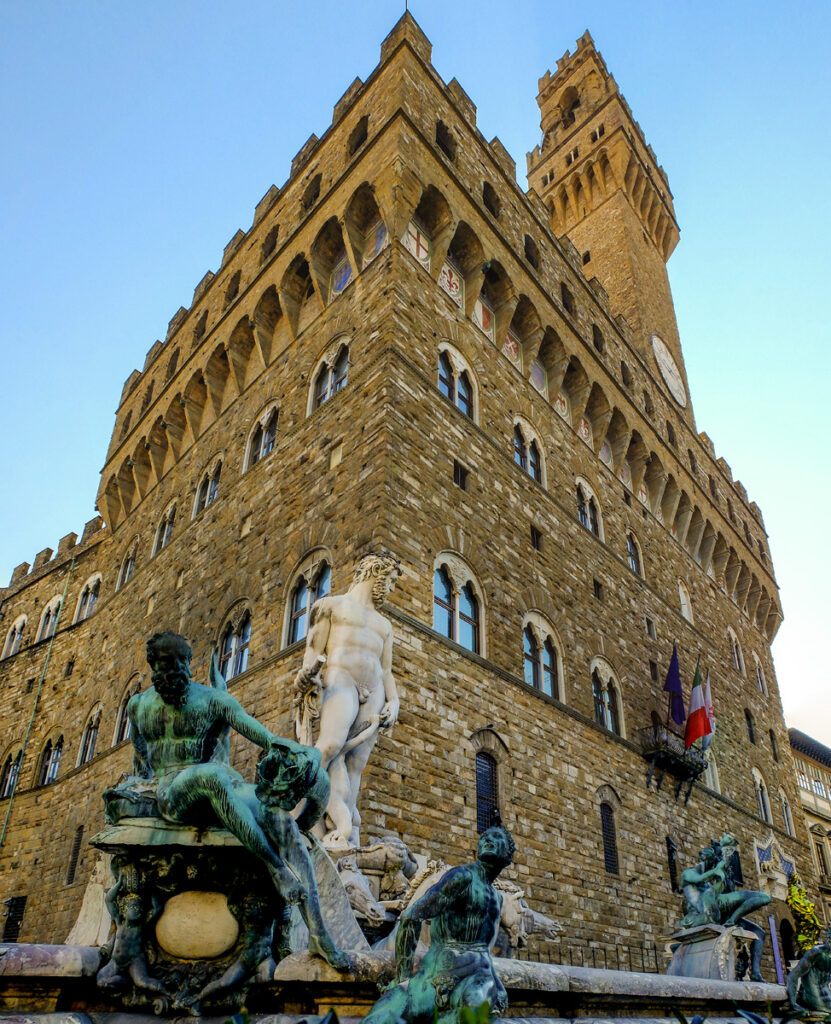 Palazzo Vecchio offers visitors Roman ruins, a Medieval fortress and amazing Renaissance chambers & paintings all in 1 attraction (Courtesy of Comune di Firenze)
I tried to visit Palazzo Strozzi afterwards, but it was closed for maintenance until the day after I left the city. This renaissance palace has a permanent display associated with its own history, as well as a selection of temporary art exhibitions. A place I would come back to next visit, and one to consider by any disabled visitor!
Day 4
- Florence Synagogue and Jewish Museum
This was another short day in terms of accessing the city’s free attractions for disabled guests. I only visited the Florence Synagogue and Jewish Museum in the afternoon, and it proved to be one of my favourites. The synagogue looks outstanding from the outside, accented by its neat and tidy courtyard and garden out front. The building was ground-breaking in its construction, which began in 1874 and the building was subsequently opened in 1882.The style chosen was Moorish and creates a lovely dark yet inviting atmosphere within the main structure. The museum features various artifacts relating to Florence’s long-standing Jewish community, as well as various texts and videos that offer a deeper insight into the history surrounding both the synagogue and the Florentine Jews.
Day 5
- Cappelle Medicee
Day 5 was another busy one, and I was lucky enough to visit 2 free sites.
 Cappelle Medicee is 1 of Florence's fully accessible attractions for wheelchair users (Courtesy of Comune di Firenze)
The first place I visited was Cappelle Medicee. This is part of the same complex as the Basilica di San Lorenzo (which I detailed during my visit on day 1). However, Cappelle Medicee has an entirely separate entrance/exit and requires another ticket – which you will also get for free with your disability certificate.
The museum is one of the smaller ones I visited during my stay – and can easily be completed in under an hour. It is composed of 3 main sections. The Sagrestia Nuova (New Sacristy – with Michaelangelo acting as the main engineer for its assembly. The Cappella dei Principi (Chapel of the Princes), a monumental mausoleum decorated completely in varicoloured marble and huge semi-precious stones – the crypt here holds the tombs of the Medici Grand Dukes and their family members. And the Lorenese Crypt, which, alongside the remains of the Lorena family, encases the funerary monument to Cosimo the Elder.
- Museo Nazionale del Bargello
Next up was the Museo Nazionale del Bargello. I had tried to visit this one before, but it has unconventional hours – if you plan a visit here, make sure to arrive early. The museum closes at 1.50pm every day, which means the last entry is at 12.50pm. That is not ideal if you are not a morning person like me.
 Museo Nazionale del Bargello is another one of Florence's architectural masterpieces
This museum is dedicated to medieval and renaissance art, and you can be guaranteed to spend much longer here as there is a lot to take in from the exhibits which are split across 3 floors.
Initially established by a royal decree in 1865, it has the historical honour of becoming the first national museum in all of Italy. Naturally, it seems like there have been a lot of changes since then – despite functioning as a museum all that time. Indeed, there were several renovations and signs informing guests of changes to the exhibitions.
The ground level contains the museum’s courtyard and the Michelangelo Room, both of which consist of priceless sculptures – including from the late great sculptor himself. The next 2 levels contain the museum’s artworks, ceramics, and antiques. These differ vastly in not only time periods, but also locations – ranging from Florentine relics to Islamic fabrics. Each room has its own clear set theme, that is divulged in info-plaques present near the entrance to each room.
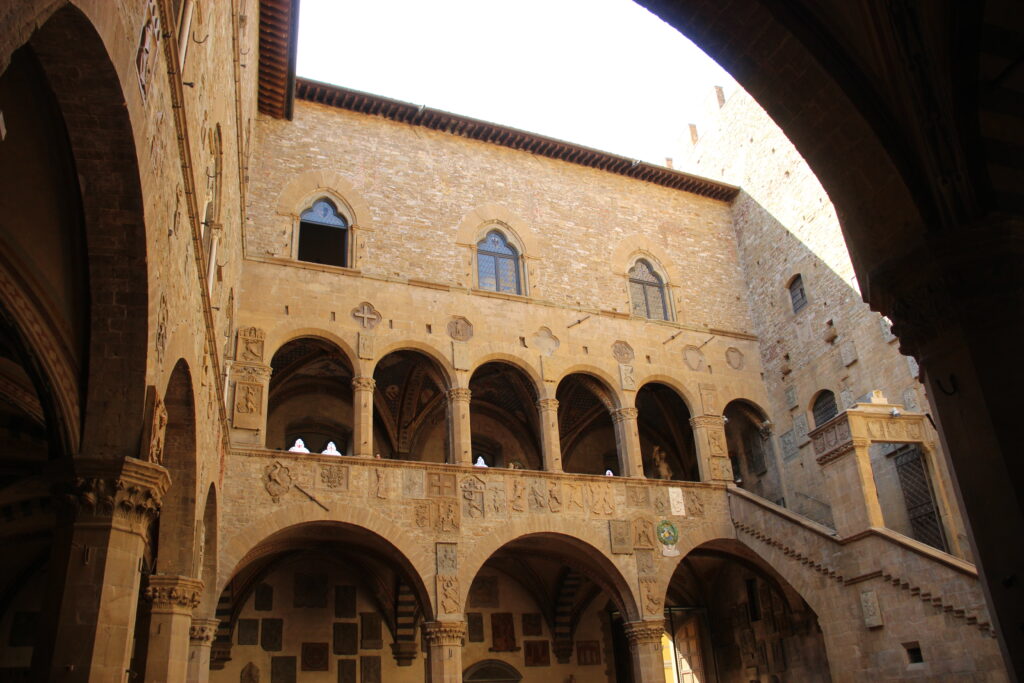 Make sure to bring your disability certificate to ensure that you receive free entrance to the attractions here
I also tried to enter the Boboli Gardens on this day, but I was oblivious to the fact that it is closed on the first and last Monday of every month (my visit falling under the latter). So, case in point – carefully read the information listed on the official website and do not always trust the hours given on Google Maps.
Day 6
- Giardino Bardini
I began my day at the recently renovated estate. This 4-hectare garden was restored in 2006 to restore it to its former glory and it still seemed somewhat of an undiscovered gem to incoming guests to Florence. The site won’t take you long to walk around, even at a leisurely pace. I would say you can easily stroll around the entire garden unhurriedly in an hour or less, but there are plenty of amazing viewpoints to be found either within the garden or from the sprawling city below with its view uninterrupted. There is also a coffee house and restaurant on site if you want to take things at an even slower pace!
 Giardino Bardini is a spacious attractions, and makes for a great afternoon outing
My personal highlights from the gardens were ‘la Scalinata Barocca’ (the Baroque Staircase) – a marvelous terraced staircase complete with marble statues, fountains and wide array of flowering plants which commands some of the most amazing views over the centre of Florence; ‘il Pergolato del Glicine’ (the Wisteria Pergola) – this sloped arbour is a place of sheltered tranquillity and is best visited in May when the wisteria is in full bloom; and the ‘il Canale del Drago’ (the Dragon Canal) – a reconstructed paragon whose pond resembles the slender body of a dragon, complete with marble embellishments and koi carp.
In the name of preservation, many of the lawns are sectioned off, so don’t expect to get up close to some of the main features. Nonetheless, I felt that I was fully able to appreciate these masterpieces without overstepping the boundaries.
You should also note that there are two entrances you can use; Via dei Bardi 1 rosso (near the Stefano Bardini Museum) and Costa San Giorgio 2 (near the Belvedere Fortress).
 Forte Belvedere is the largest fortress to be built in the city (Courtesy of Comune di Firenze)
- Villa Bardini/Belvedere Fort
These two sites, I have combined because not only does the ticket include entry for both, they are also two halves of one exhibition.
Villa Bardini is within the grounds of the gardens, though you will need a separate ticket to go inside, so just be prepared to give proof to gain free entrance here. Again, either of the entrances to the gardens can be used to reach the villa.
The museum features a permanent display, ‘the Annigoni Museum’ – devoted to the Florentine artist Pietro Annigoni’s many works. The temporary exhibition during my visit was labeled ‘Photography’. More specifically, it focused on many creative aspirations undertaken by female photographers from Italy and beyond.
 Giardino Bardini offers both outdoor and indoor attractions that visitors can check out
Fort Belvedere features the second portion of the exhibition, as well as a temporary visual exhibition on the ground floor. You will have to show your ticket to staff at the entrance to the fort to revalidate the fortress portion of the tour – which was slightly confusing but did not prove to be a major headache.
- Giardino di Boboli
As I mentioned, I missed out on this previously due to my inattentiveness, so I went back this day. The ticket comes with the ticket for Giardino Bardini (regardless of whether you got the ticket free or not), so you won’t need to get a ticket twice – just go to the desk and present the ticket you already have.
 Giardino di Boboli is huge, so it is worth setting aside several hours if you want to fully explore the grounds
These gardens encompass an enormous area, so be prepared to spend at least 2 hours here if you don’t want to just do a quick flyover. They didn’t seem to have any handheld maps to provide for visitors upon arrival, which isn’t ideal for those such as myself who are over-reliant on them for large sites. I decided to just use my ingenuity and take a picture of the map at the entrance to use while walking around.
There are many different sections to explore, some more impressive and better maintained than others. As a particular fan of seeing flourishing gardens, the Gentleman’s Pavilion, Botanical Gardens, and Lemon House proved to be my top 3 highlights. Certainly, I did spend much of my visit between these 3 sites. The Island Basin with its centrepiece, ‘the Fountain of the Ocean’ is also a must-see.
 Originally designed as a plant nursery, the Grotta Grande of the Boboli Gardens is now covered with sponges, rocks and other heterogeneous materials, in order to provide a scenery to fountains, water features and sculptures (Courtesy of Comune di Firenze)
There are three entrances/exits you can make use of. The first is at the entrance of Pitti Palace – as the gardens are historically connected to this site. The next is at Porta Romana – further down the street from the main entrance of Pitti Palace. The last can be found at Belvedere Fort – this was the one I used.
Day 7
Following a drastic change in the forecast (for the better), I decided to venture out and visit the furthest away attractions on my list that I had yet to complete.
- Uffizi Gallery
One of the most popular attractions in all of Florence, I ended up visiting this towards the end of my stay. This prominent art gallery is located adjacent to the Palazzo Vecchio, and features some of the world’s most esteemed artworks (even if you don’t realize it until you arrive).
 Uffizi Gallery contains some of the world's most famous art pieces (Courtesy of Comune di Firenze)
The gallery is housed in an enormous building built in the 14th century, and still occupies a substantial portion of the structure. You will want to make this a full day’s activity as this attraction encompasses a huge site, and even a rush-through will easily take you over an hour or two.
The building consists of various sections, built around a marble statue-laden corridor, with various galleries allocated in the abutting rooms. Numerous works by the greats are housed here, including Michelangelo, Leonardo da Vinci, and Botticelli.
The museum does contain of a mixture of artworks and sculptures, each with a written explanation. Which I felt was perfect for both visual and written learners.
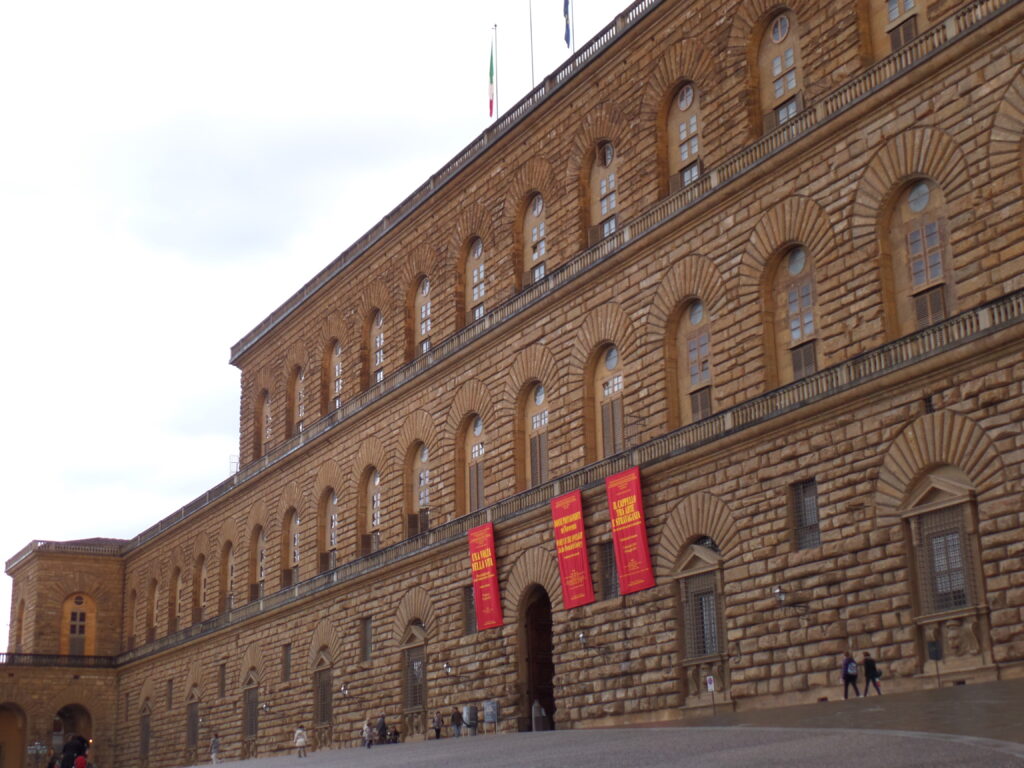 Pitti Palace is another large attraction that you should allow time for (Courtesy of Comune di Firenze)
- Pitti Palace
I decided to make a trip over to Pitti Palace (having already visited its gardens the previous day). This is another huge site. The main core of the building dates to 1458, and it was originally a town residence of Luca Pitti, who was well known as a zealous Florentine banker. Eventually acquired by the Medici family around 1550, the Palace was subsequently selected as the new Grand Ducal residence, and it eventually became known as the new symbol of the Medici’s power over the Tuscan region – then its own Republic within the world order.
Today the Palace is divided into four museums visitable by guests: the Treasury of the Grand Dukes on the ground floor, the Palatine Gallery and the Imperial and Royal Apartments on the 1st floor, the Gallery of Modern Art and the Costume Museum, both of which are on the 2nd floor. The latter of which was closed for renovation during my visit. Nevertheless, this is easily a 2-hour activity due to its overall size, so be sure to plan your day around this if you do decide to go.
 Michelangelo's David, an attraction everyone should recognize
Day 8
- Galleria dell’Accademia
We come to my final day of accessible sightseeing! I decided to save the best for last – one of the city’s most recognizable attractions; the Galleria dell’Accademia – which houses Michaelangelo’s iconic David sculpture.
I found this one a bit challenging. Whenever I passed by, there were always crowds outside – which I found slightly intimidating. What’s more, there are 3 or 4 lines. I remember reading each one several times and just not being able to process it all. There was staff present, of course, but I didn’t quite have the confidence to ask them which line I should join.
I decided the best course of action was to message the museum directly. They responded with details that I just had to speak to one of the staff members monitoring the queues outside, and having the certificate would allow me to skip the line (this is the case for all museums offering free entry to disabled visitors). So, the following day, I found a staff member, and they directed me to another entrance which takes you right through to the security checkpoint. I then found out that the first Sunday of the month is the day that all state museums offer free entrance to all, so I was getting free entrance this time regardless! It pays to double check these things!
 While David is the mainstay for visitors, Galleria dell'Accademia contains many other wonderful pieces worth seeing (Courtesy of Comune di Firenze)
The museum itself is mid-sized and features several rooms with distinct themes. The gallery is home to some of the most important art collections in the world, including a rich collection of early Italian artwork that has been fabulously preserved. Most of the collections are Christian-related artworks, but they also have a dedicated display of musical instruments and the grand gallery featuring David and several of Michelangelo’s other works. David has been in the museum continuously since 1873.
The work was commissioned for the Florence cathedral in 1501, from a block of marble that the artist found in the courtyard and subsequently enquired about. The sculpture depicts David from the Goliath story in the Bible’s ‘Book of Samuel’. It is not clear if the sculpture was intended by Michelangelo to portray him before or after the battle.
 David lives up to its fame, Michelangelo having even meticulously carved the veins in the statue's arms
Upon completion 3 years later, it was decided that the sculpture should be placed in the Palazzo Vecchio, as it was seen to be symbolic of the strength and independence of the Florentines. A little-known fact is that some parts of David were gilded – these embellishments are now long gone.
It is easy to see why this is one of the most (if not the most) renowned sculptures in the history of the world. Michelangelo clearly poured his artistic soul into this, and it really shows when admiring the statue up close. The level of detail is unparalleled – even the veins protruding from the skin across various parts of the body have been precisely chiselled into something that is beyond human.
With such an iconic work housed here, the museum was very crowded (being a free day for all didn’t help either), so that is something to be aware of for anyone who gets easily overwhelmed by crowded environments.
Final Thoughts
This is, of course, not an exhaustive list. Far from it, there are still several more museums which are part of this initiative that I didn’t go to this time around. Some I couldn’t make it to that I’m aware also offer this include; San Marco Museum, Galileo Museum, Marino Marini Museum.
 Florence is crammed with historical, artistic and architectural beauty that make it an ideal destination for many tourists
Both the Archaeological Museum and the Opificio delle Pietre Dure Art Gallery also offer free entry to guests in possession of a combined Uffizi Galleries/Pitti Palace ticket that is valid for 5 days. This applies to all guests in possession of this. While I didn’t take this particular ticket, it was offered to me for free with my certificate at Pitti Palace, so I would recommend specifying to the ticket operator that you want this particular ticket when you go.
While not Florence, my biggest gripe was trying to go to the Leaning Tower of Pisa for a day trip (it is still part of Tuscany). I read the specific instructions online before planning my day trip to make sure that I understood everything that was expected of me in order to get the free ticket. I had a couple of queries outstanding, so I emailed the relevant contact on their website. I received a response not too long after, which answered my inquiries – but presented a new challenge that I wasn’t aware of before: disabled visitors could only get a free ticket by being accompanied with their companion/helper. Naturally, I responded by explaining that, while disabled, I did not need a companion, nor was there anyone around that I could take with me for when I was planning to go. This protest was futile, however, and I was told it was policy. I’ve encountered this 2 or 3 times in different locations now, and I just want to say this terrible policy to assume that everyone disabled needs a carer/companion, and also deny any without one the benefits that would otherwise be open to them. I didn’t have enough spoons to continue the conversation after that. It is really exhausting trying to fight this stuff that is exists on an institutional level, it’s absolutely ludicrous.
 All of Italy's government owned attractions are free for disabled travelers, so keep this in mind when visiting the country
I had a blast in Florence. Normally, I end up missing out on visiting attractions because of high entrance fees, so it was nice to be able to fully immerse myself in some of the best attractions that this Tuscan treasure trove has to offer. It’s no secret that disabled people are more at risk of poverty than those who are non-disabled, so it is fantastic to see initiatives like these to actively encourage disabled visitors to these attractions with free and easy access.
Anybody considering a visit to Florence should know that there are some popular tourist sites which everyone must pay the regular entrance fare for, regardless of disability status. These include; Opera del Duomo Museum, Giotto’s bell tower, and the Baptistery. Others (notably the Cathedral di Santa Maria del Fiore) are free for all visitors.
Check out the accessibility section of the official Florence tourism board here for more information to help plan your trip.
Note: A special thanks to Comune di Firenze who kindly provided additional photography for use in this article. All credit goes to the rightful owners.
If you liked this article and would like to support my work, then please consider clicking on one of the buttons above to donate a little to either buy me a coffee or support my business initiative. Your generous support enables me to keep creating new and better content, as well as cover business development costs. Please only do this if you are financially able to do so, as these are challenging times for us all – Thank you!
I could not resist commenting. Exceptionally well written!
I’m glad you enjoyed reading about this beautiful city!
Awesome post.