
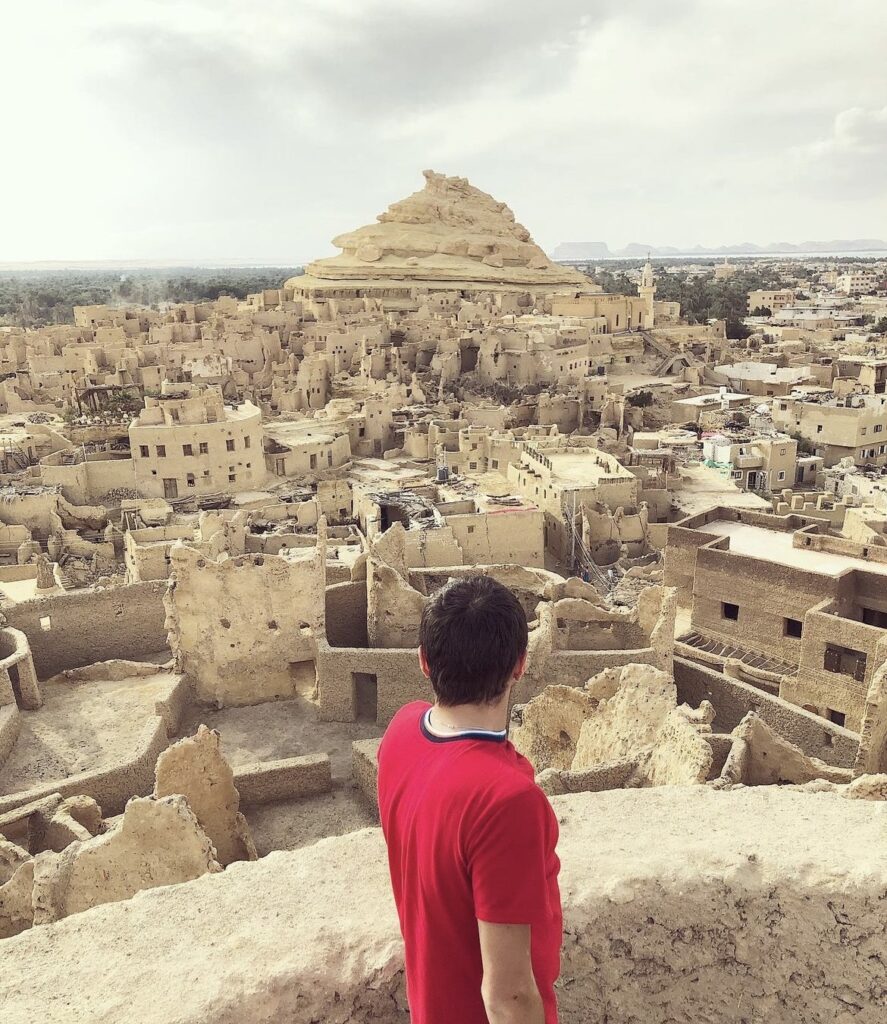
 Siwa is fully of activities for tourists, pictured here is the Shali Fortress
Siwa Oasis is one of those magical places that I only found out about through the equally magical power of networking. Having flown into Sharm El-Sheik to meet my travel buddy, Julia, for our Egyptian journey, we were planning our next move when we learned from a Canadian couple in the same hotel as us about Siwa – which they had already come back from. Just looking at their photos was enough to make us throw our itinerary out the window and prioritize at least a few days to go here.
The area is unlike anywhere else in Egypt, with the local Berbers retaining the uniqueness of many of their cultures and customs. Everything down to the foods, drinks, clothing, and souvenirs are peculiar to this area – so make sure to do some sampling while you are there!
Basics
The Siwa oasis is a mid-sized urban oasis in the Western Desert, located a mere 30 miles (50 km) east of the Libyan border. The oasis is in a deep depression that extends below sea level (approximately -19 meters / -62 feet). It is inhabited primarily by the native Siwi Berber population, who speak both Arabic and their native Siwi language.
 Surrounded by the Sahara Desert, this place lives up to its title of 'Oasis'
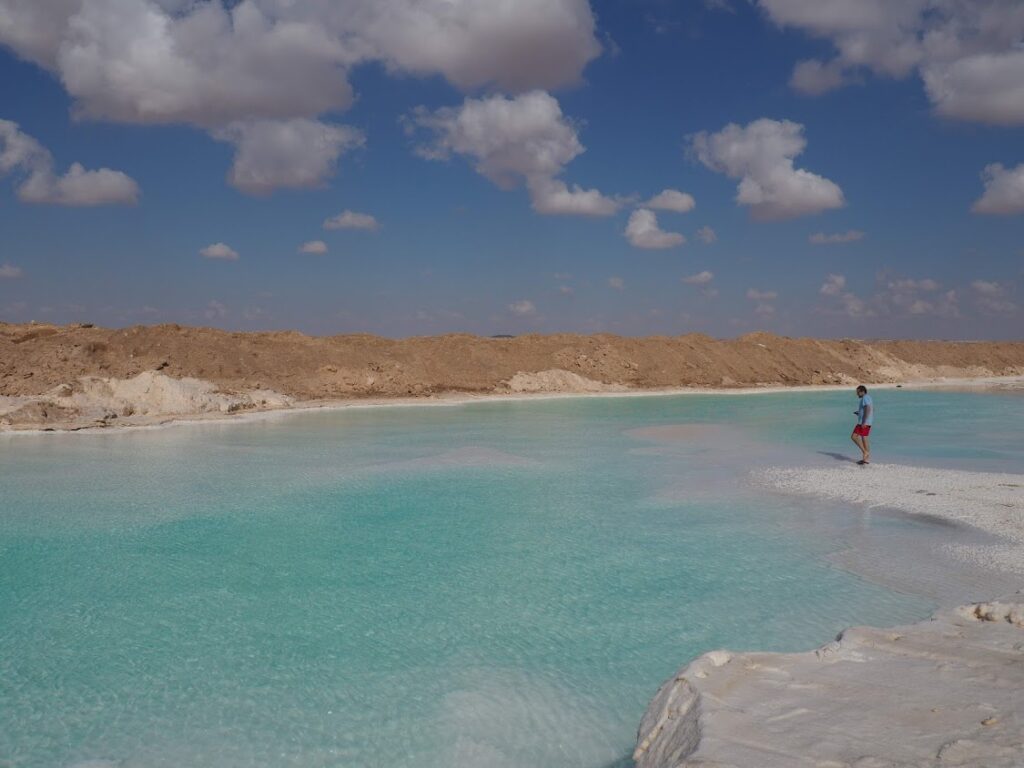 An example of the incredible salt lakes you can visit in the area
 The water here is unlike anything else I have seen
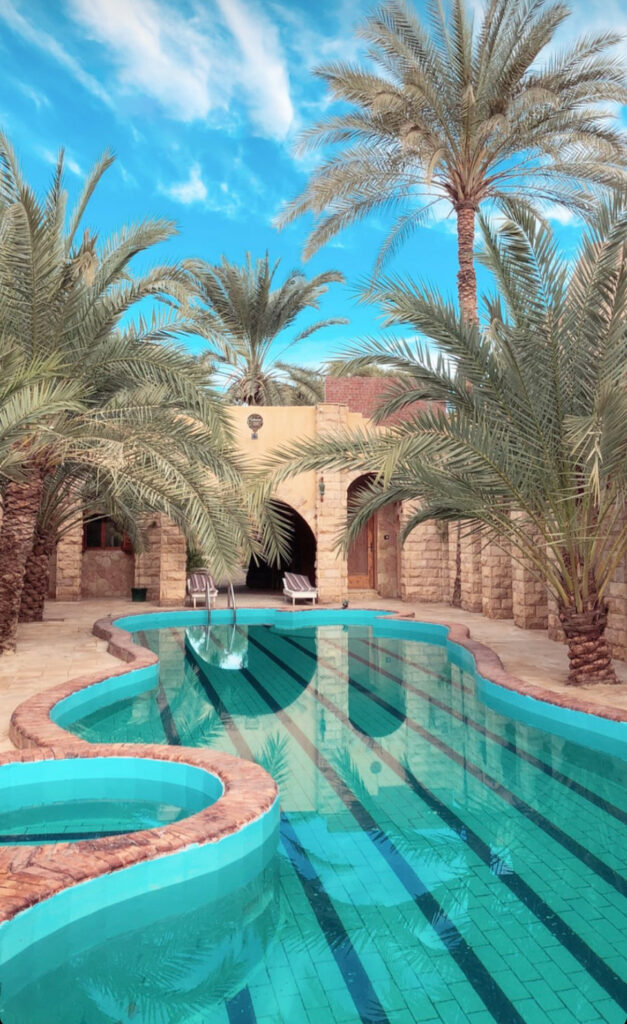 The perfect morning view to wake up to
Facts & History
There is evidence pointing towards humans having settled there as far back as the 10th millennium century BCE, though its connection with the Ancient Egyptian civilization goes back as far as the 26th Dynasty (dating from 664 to 525 BCE). Greek settlers eventually inhabited the area not long thereafter. Historical records show that the Siwans resisted an Islamic army who entered the area in the 8th century and did not convert until the 12th century.
Siwa was also notable for its homosexual traditions – having a longstanding historical acceptance of male homosexuality and customs that celebrate same-sex marriage. This is said to be traced back to a local practice of forcing young boys to live together outside of the old town walls until they got married, without any interactions with women until that time. These traditions have since been suppressed by Egyptian authorities beginning in the early 20th century.
How to Get There
By far the biggest challenge is getting to Siwa. It is found in a remote part of the Sahara Desert, close to the border of Libya – and far away from any significant human settlement. It has no airport and is not near the coast. So, you must either take a bus or rent a car. We opted for the former, and I personally recommend this – as it will be a lot cheaper than a car and will remove the added stress of being the lead point of contact during military checkpoints (these are inevitable).
 Sunset is always an amazing sight wherever you are in the desert
We left from Cairo, which is your best starting point for reaching many other parts of the country. However, there aren’t any direct transport options to Siwa from here either. You will have to first take a bus to Marsa Matrouh to get to Siwa. This also happens to be the closest airport to Siwa, so if you are specifically coming to Egypt for Siwa, then be sure to look at flights to here.
GoBus is the go-to coach option when traveling in Egypt. It is cheap and cheerful, so do not expect a high standard, but it does the job (and is by far the easiest way to get to the oasis). It is imperative that you book your ticket beforehand to ensure that you have a seat.
Buses leave incredibly early, and it takes around 5/6 hours from Cairo to get here (there are several rest stops along the way to gather snacks and stretch your legs).
From Marsa Matrouh it is a bit more complicated. You cannot book the bus ahead of time. Instead, you will have to find the designated bus at the local bus station. There were no visible signs on the buses and the person at the information point did not speak English, which was a bit stressful. But we eventually found someone who spoke English and told us the time and place the bus would arrive. He invited us to his café, where we sat and drank some freshly brewed tea until he pointed out the bus had arrived.
 Like the rest of Egypt, there are plenty of adorable friendly street dogs looking for attention (and food)
You will have to pay the driver directly before getting on. The journey to Siwa from here is, again, around 6 hours and will drop you in the center of town. From which point, you can either walk to your accommodation if it is nearby or take a local taxi/tuk-tuk (there will be plenty waiting by the bus stop).
It is an exceptionally long day of traveling (it was around 14 hours in total since leaving Cairo). The key point is to take an early bus to ensure the connection at Marsa Matrouh. If in doubt, I recommend double checking with your accommodation provider as information online can often appear convoluted, and when it came to the journey it was impossible to find any kind of timetable in Marsa Matrouh – with the bus not arriving at the time we were expecting.
What to do
The best way to move around Siwa is to get yourself a local guide. While it might be possible to move around independently to some degree, the attractions are spread far across the oasis, so having a set of wheels will save you a lot of time and effort. Our plan was to ask at our accommodation, but we were promptly approached by a friendly local named Hamza. We were sceptical at first, but he gave us an offer we could not refuse to be our driver and guide for the entire duration of our stay. After our agreement, he kindly dropped us off at our hotel, and exchanged WhatsApp contacts to start our tour the following morning.
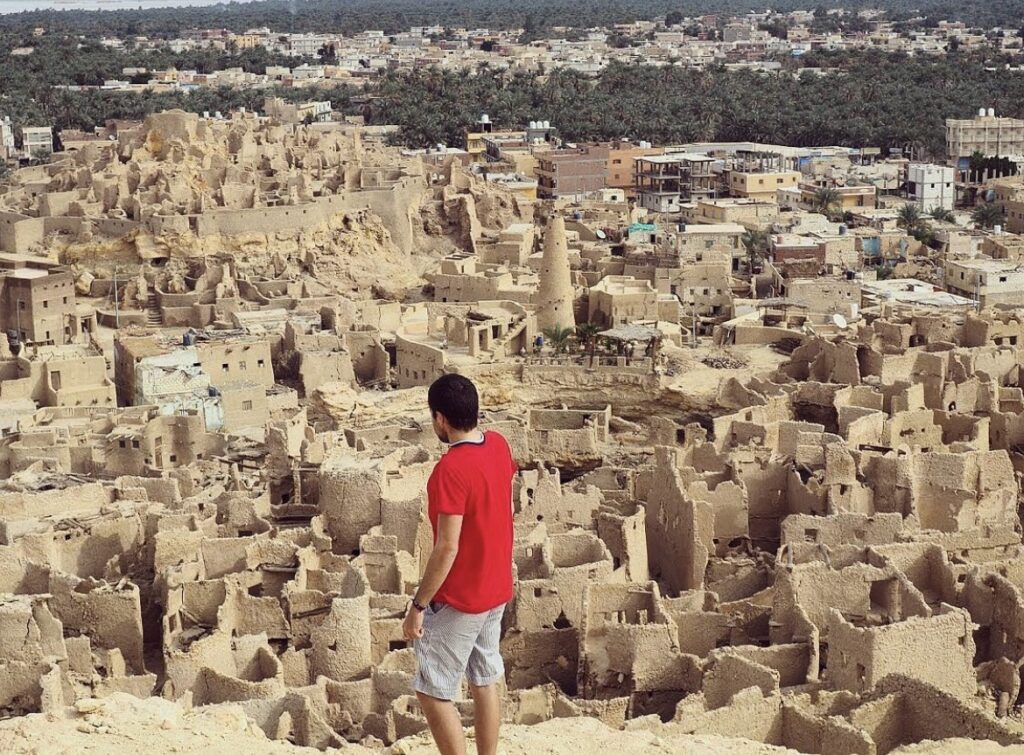 Make sure to do the hike up the fortress for some amazing views
- Old Town of Shali
Shali is the remains of an old 13th century mud-brick fortress towering above the modern habitations in the town center. The former settlement is composed entirely of a mixture of local salt, rock, and clay plaster (kershef). It has degraded naturally over its long history, but many of the structure’s visages are still quite clear.
It is like nowhere I have seen before, so make sure to stop off here when you get a chance. The hill on which the fortress sits upon centrally has some of the best views around – you can even see as far as where the desert starts in the distance!
Much of the damage has been attributed to 3 days of rain that occurred in 1926. Subsequently, over the last few decades, inhabitants moved to newer, sturdier and more comfortable homes, leaving much of the complex abandoned. Now, only a few structures around the periphery are occupied or currently in use.
 Cleopatra's Pool may look unassuming, but it is a great refreshing dip
Tourists can use a pathway from the central square that allows you to explore the site in its entirety, and – as mentioned – ultimately leads to the top of the fortress for some superb views over the oasis.
- Cleopatra’s Pool (Cleopatra’s Bath)
One of our first visits in Siwa was to this amazing natural spring. It has been restructured into a large circular stone pool. As Cleopatra never bathed here, I am unsure of the significance of the name. Just make sure to bring your swimming gear as you will not want to miss the opportunity to go swimming here. It is popular amongst both locals and tourists alike, but luckily, we were the only ones there when we arrived, so we had the whole place to ourselves.
A couple of small cafés surround the pool serving a selection of drinks and snacks that you can enjoy after your dip. There were several adorable puppies lounging about here too, so I couldn’t resist the opportunity to play with them.
There are many natural springs here though, Siwa is famous for them despite this being the most famous. Many are now situated within private properties nowadays. However, as our guide was friendly with some of the owners, we got to visit many along the way – a highly appreciated experience!
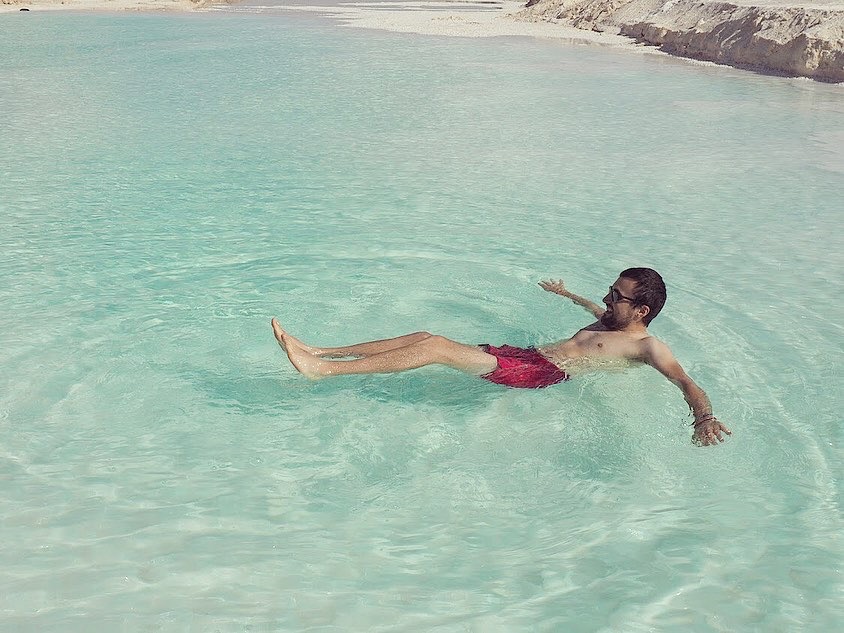 If you've never been to the Dead Sea, then this is the next best thing!
- Salt Lakes
No visit to Siwa is complete without a visit to one or more of its salt lakes. I am sure many of you will have seen the photographs of people floating effortlessly in the Dead Sea while reading books; well you are more than able to do this here too – just the lakes are on a much smaller scale.
We made numerous stop-offs while touring the lakes, and while some of the lakes are large (Lake Siwa being the largest), some can only be described as small deep pools. Given their mystical appearance, they also make for great photographs.
Just remember to take a towel and a change of clothes, as you will feel sticky afterwards, thanks to the heavy levels of salt present in the water.
 Some toppled pillars at the Temple of the Oracle of Amun, which still bear faint hieroglyphs
- Temple of the Oracle of Amun
Also dating from the 26th Dynasty, the remnants of this temple are far from being the best preserved in the country, but should be visited by history buffs all the same. Whilst a mere remnant of its former glory, there are still several pillars with inscriptions still clearly visible.
As the name suggests, the temple was dedicated to the god Amun and was strongly seen as a symbol of Siwa’s wealth. This temple brought pilgrims from all over Ancient Egypt, the most famous of all being Alexander the Great – who was declared as Son of Amun following his pilgrimage.
- Great Sand Sea (The Western Sahara Desert)
Siwa is a small oasis in the middle of the desert, so it would be rude not to take a quick trip here. Our guide took us to his favorite spot which had enormous sand dunes and presented us with a sandboard to take a ride down the slopes. It was my first time doing anything like this, but it was a lot of fun. Sitting down is the best way to enjoy this, standing up is just a little too risky.
 Exploring the vast desert which encircles the small oasis
Afterwards, we drove a little further to a flat portion of the desert for sunset. There was sand as far as the eye could see. It was a strange feeling bearing witness to it – but it made for an even more enjoyable sunset.
- Fantasy Island (Fatnis Island)
Located at the edge of Siwa’s Birket Salt Lake, this idyllic palm-shaded paradise is accessible via a long narrow causeway.
You can walk around the lush palm groves here, but the best part about this place is the water’s edge where the café is found. We went here twice during our stay for the sunset, and it was truly out of this world. You will have to make a purchase at the café to enjoy this spot though. Also beware of the mosquitos that come in droves as soon as the sun sets.
 Fatnis Island is the perfect sunset spot to visit in Siwa
- Mountain of the Dead (Gebel al-Matwa)
Another small mountain located in the center, this place is a must visit for those with a particular interest in archaeology. The reason being that the hilltop is riddled with tombs and caves from the 26th Dynasty period up until the Roman Period. Not much remains of the tombs other than their hollowed insides nowadays, but towards the top we met a friendly local who invited us for some fresh Arabic tea near the top. He turned out to be the attendant of the mountain and was intrigued to hear our story. After a nice conversation, he led us to the other side of the mountain where another local guarded a locked door leading into a cave. The guard opened the door for us, and we entered the Tomb of Si Amun.
This is the best preserved Ancient Egyptian tomb in the area. Thought to be built for a wealthy Greek landowner or merchant, the brightly colored reliefs depicting the man praying to Egyptian deities remain in excellent condition.
Also located on this mountain is the unfinished Tomb of Mesu-Isis, with beautiful images of cobras in red and blue above the entrance, and the Tomb of Niperpathot, with various inscriptions still visible, as well the Tomb of the Crocodile.
 Mountain of the Dead (Gebel al-Matwa) has the best preserved ancient Egyptian tombs in the area
- The White Mountain (Adrere Amellal)
This is one of Siwa’s lesser explored attractions, but that doesn’t mean it is of lesser interest. In fact, this was a highlight of my time here. The imposing mountain is on the western side of Lake Siwa, standing proudly behind several eco-lodges that have been set up at its foot. We learned that the entire area was once deep under water millions of years ago, meaning this mountain was originally a seamount.
It is possible to climb the mountain, and while we didn’t go all the way up as the heat was very intense, we encountered some amazing things. The rocks on the mountain side are overflowing with fossils of sea creatures long gone; coral, sponges, sand dollars, sea anemones, shellfish, and ammonites are just some of the amazing fossils we came across while hiking up the side of the mountain.
We were told afterwards that the world’s largest whale skeleton was also found in the desert at Siwa. It really puts into perspective the ever-changing nature of the world that we live in.
The mountain also offers some outstanding views of the lake and surrounding desert landscape.
 The White Mountain (Adrere Amellal) gives visitors a real sense of the evervchanging world we live in
Where to Stay
There are no hostels in Siwa, but that wasn’t so much of an issue as there were numerous hotels and camps (Siwa’s answer to the hostel experience). We started our journey in a lovely little boutique hotel; the Siwa Paradise Hotel. It was far from glamorous, but it had a lovely set up, with the rooms built around a large open garden area with palm trees and a swimming pool. Breakfast was a highlight for me. It was one of the best I had during my time in Egypt. The owner offers some of his own activities, but we didn’t require any, having already committed ourselves to our driver.
We eventually moved to Mountain Camp Ali Khaled, having become acquainted with some of the other guests there (and having received a recommendation from the Canadian couple who we previously met). Ali Khaled is the energetic owner, who you will no doubt become acquainted with during your stay.
The camp is built around a natural spring that you can have a dip in anytime you like. This is perfect during nightfall when the temperatures are low. It also has a large open space, with many gardens and other curiosities found between its lodgings. Find yourself a nice hammock and just chill out if you feel like you need to put your feet up!
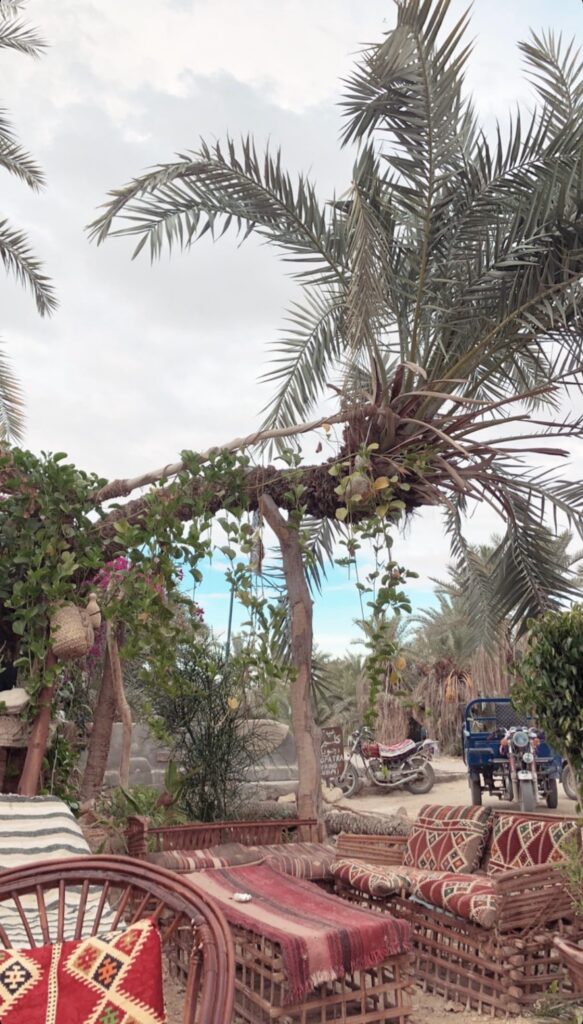 There is no shortage of delicious restaurants that visitors can sample local delicacies around town
Other Things to Keep in Mind
Bring plenty of supplies for the journey to Siwa Oasis. You will need them. There are plenty of rest stops along the way, but you might get hungry/thirsty before you get there – so it is best to be prepared.
The bus toilets were grim, so if you could, I would try to hold on until the rest stop. Though there is no guarantee of cleanliness there either, all public toilets in Egypt charge a small amount to use them.
As mentioned, the journey has several military checkpoints. This is standard procedure in Egypt, and they will just briefly check everyone’s ID/Passport, so make sure you have it to hand when on the bus.
When mobile coverage exists in the oasis, it is extremely limited and appears to differ depending on your provider – so be prepared and download maps beforehand if you think you will need them.
Siwa welcomes tourists as it is a major source of income for many, so they are lax when it comes to female tourist’s swimming costumes choices for the local springs and salt lakes, but I would recommend being mindful to local cultures wherever you go.
 2 grand salt lakes separated by a narrow road
 Enjoy the desert sunset in the Sahara
 Sitting atop the mountain of the dead
If you liked this article and would like to support my work, then please consider clicking on one of the buttons above to donate a little to either buy me a coffee or support my business initiative. Your generous support enables me to keep creating new and better content, as well as cover business development costs. Please only do this if you are financially able to do so, as these are challenging times for us all – Thank you!
Leave a Reply