
 Lydia's new book is out now and available to purchase
As many of you may be aware, there is very little in the way of travel-related information online which focuses on autistic adults, or has any input from the autistic travel community.
‘Autistic Travel Voices’ is an opportunity for others in the community to discuss topics surrounding their own travel journeys, and how their lived experience of traveling intersects with being autistic.
In this new edition of ‘Autistic Travel Voices’ I had a chat with Lydia Wilkins, who currently works as a freelance journalist covering a range of disability & social issues, and is also an ambassador for AccessAble. Lydia has also recently released her first book; The Autism Friendly Cookbook, which is now available on Amazon for order. Her rich insight into the intersections she has experienced between being autistic and her time spent traveling and engaging with the tourism industry made for some great responses which you can read below.
 1251 Avenue of the Americas, during Lydia's trip to New York City
- Q1: Would you like to introduce yourself to our readers?
Hi! My name is Lydia Wilkins, and I am a freelance journalist who specialises in disability and social issues. I have written for The Metro, Insider, Refinery 29, and others. I also write on Substack , a platform for independent writers, as The Disabled Feminist, and there is also a podcast of the same name to go with this. I am an ambassador for AccessAble, and my first book was published in November last year.
- Q2: When was your first solo trip? And where did you go?
Back in March 2020 I turned 21 – and I was incredibly lucky to go to New York! Technically speaking, the first time I had been on a trip was in November 2018 – at 19 – on a work-related trip to Germany. I count New York as the first ‘proper’ trip – it wasn’t work-related and was for fun. It was…. Interesting! I arrived just as Covid 19 arrived in the States. Everything closed as I touched down! You must learn quickly about what to do in a crisis…
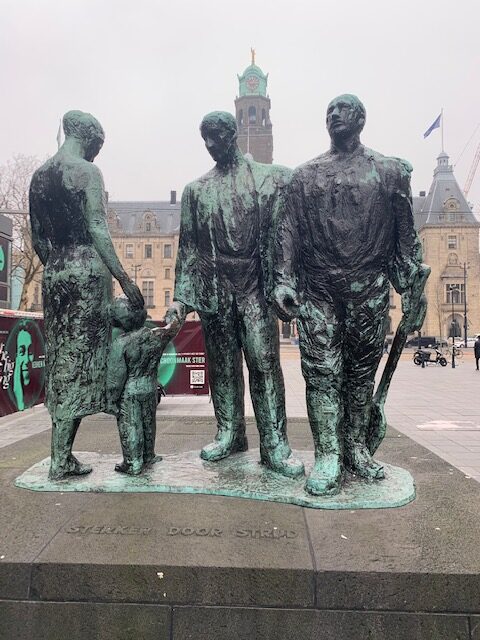 Lydia provided some of her favorite images taken throughout her travels
- Q3: Tell us about what travel means to you? For example, are there things you always like to keep in mind when you travel or are there certain ways in which you like to travel?
Travel is something I have a complicated relationship with. I was diagnosed as Autistic when I was a teenager – but it took longer still to learn I needed adaptations in place, no one framed autism as a way of being, nor did they tell me this was why I found travel hard – it causes me pain due to sensory issues! It is not me just being bratty! I was often made to feel like this – people still think I can somehow just snap out of my own neurology. Travel is still somewhat inaccessible to me – because airlines are so damn insufferable, and so bitterly ableist! – but I do a lot of travelling around the U.K. Travelling means there is time set aside for me, I am allowed to dream and to explore. Travelling allows you to learn about yourself and others, it creates a sense of curiosity. It is nurturing, and great for good mental health.
- Q4: What have you learned about yourself as an autistic woman since traveling solo?
That Autism is a legitimate disability! It is not my damn superpower! I have learned to adjust and to assert my rights. There is nothing wrong with my existence – I will go at my own pace. I have learned to be curious, more so than I thought I was, I have also learned to people watch. It’s freeing. In a culture that is not built for you, this is an escape.
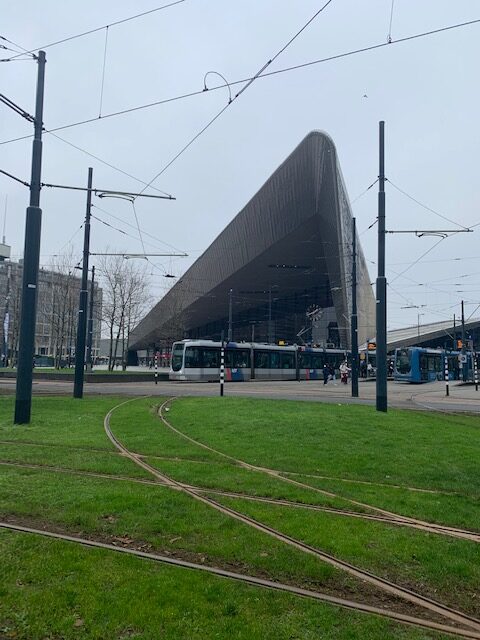 Rotterdam Central Metro on a cloudy afternoon
- Q5: Does your work ever take you away to new locations? If so, do you feel any major differences between traveling for work or pleasure?
Yes! Definitely. So, I freelance – a lot of the time this means I am in locations around London, I was in East Croydon a lot last year. I sometimes cover events in Brighton, occasionally in Lewes in East Sussex – and, on occasion, it can mean going further afield. (Especially if filming for AccessAble – or for conferences like Naidex, up in Birmingham). I think there definitely is a difference when I am by myself, I find it a lot easier to manage, as sometimes people who I work with have no idea. I find things like changing routes and using buses extremely difficult – I cannot do it! Working away adds a pressure of sorts.
- Q6: Do you have a favorite travel memory that you feel relates to you being autistic in some way?
When I was a trainee journalist, I travelled to the Royal Automobile Club in London – it was the first time I had done such a thing. It took a lot of planning, and a lot of detail to execute, and I was by myself. I had gone to meet my mentor, Harold Evans – I miss him. He took a lot of shame away in mere seconds around my ASD and talked to me like a human being. It is not specific to travel as such – but the feeling of ‘I did that’ was immense, and very addictive. The detail of the RAC was just extraordinary to my untrained eye – the gilt walls, the fancy car on display, a mesmerising chandelier….
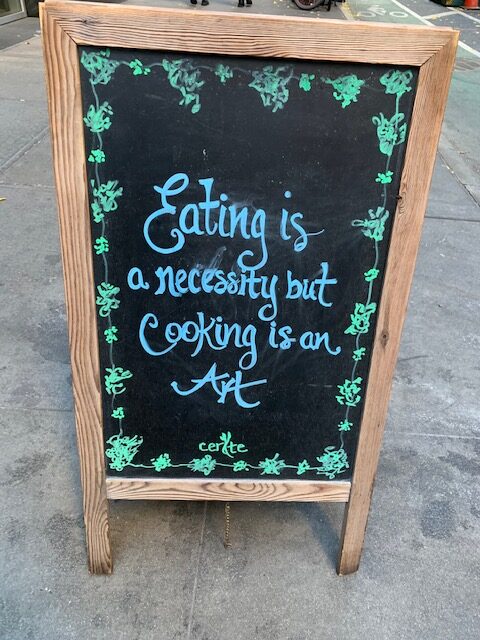 Lydia has a real passion for cooking
- Q7: Have you ever felt/noticed any differences in cultural perceptions to autism while in societies/cultures different to your own?
America was just so interesting, everyone wanted to help me, and had no shame around ‘Autism’. I am not a fan of ‘with Autism’ however – it did occasionally have overtones of tragedy attached. At times I had suspicious looks – such as when backing away from a 5th Avenue Christmas Light Show! Not fun to be stuck in. I felt so at home when I first visited Rotterdam, it was a city I fell in love with – I was accepted, disability was front and centre, and I could be myself entirely. So, I could stim (usually I suppress this), look at street art, explore bookshops – and I was treated like royalty because of my day job. This was unlike the U.K where I often feel like I am being punished. But that is another story…
- Q8: What challenges does being autistic present for you when you are traveling and what strategies do you use to cope?
How long do you have? My sensory issues, poor theory of mind and executive functioning, terrible interception… make navigating a hostile environment almost impossible. I have ear plugs, a planner always to hand within which I will have extensively planned out any trip, usually I have food and water with me, and a tangle. I am also a Long Covid patient, which means I also have a snazzy walking cane. I usually have a soft jumper, and clothing is based on layers to cope.
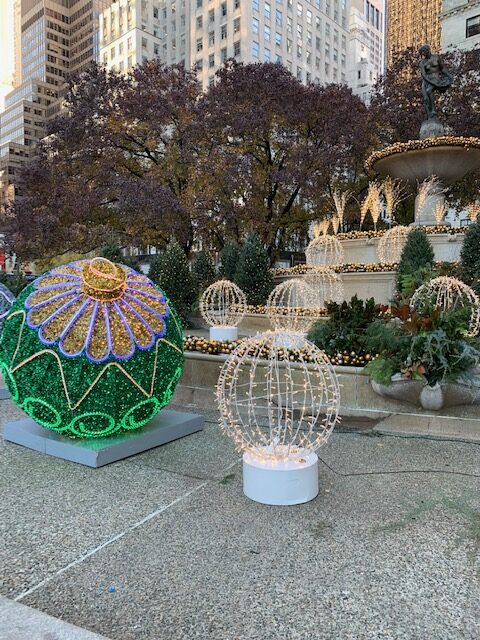 NYC kitted out with large Xmas decorations in time for the yearly festivities
- Q9: From your own experience, how accessible do you feel the tourism industry is for autistic travelers? Do you have any suggestions for improvement?
In a word: nope. It never has been. Listening to disabled people and proactively taking feedback on board is a start, rather than just fobbing us off. Airlines are the worst for this. I have had some horrible experiences – but I am not a free educational resource to just pick the brain of. Making changes that work matters – if you want travel and tourism to come back post pandemic, inclusion matters. These sectors cannot afford to not include us anymore.
- Q10: Do you have any advice/tips to share with other autistic adults looking to travel solo?
Plan! Use whatever way works best for you to plan, pinpointing every single detail you feel anxious about. I have an amalgamation of a bullet journal and my own notebook – every train journey is written out; any longer journey has a specific set up. This allows me to be flexible and to have all information at my fingertips. Looking at the resources on offer can also be helpful – sometimes some airlines have additional assistance, though I really hated this last time I travelled, so much so I had a meltdown. Have aides in your bag such as headphones, stim toys, etc.
If you would like to keep up to date with Lydia and her work, then you can find all her links over here.
Leave a Reply