
 A 17th-century warship, 98% original–preserved beyond belief
I have visited countless museums across the world, many covering the same types of themes – art, archeology, culture, anthropology etc. But I have yet to visit any quite like the Vasa Museum in Sweden. So, what is it exactly that makes this museum so special? Well, for starters, it houses the ill-fated Swedish warship Vasa, which dates to 1626. Eventually salvaged – largely intact – from Stockholm harbor in 1961, nowhere else in the world can you see a 17th century ship at quite the level of preservation of the Vasa. You don’t even have to be a history lover to appreciate the spender contained within this museum’s four walls. So, if you ever find yourself in Stockholm, then you need to make a visit to this museum a priority!
Disclaimer: I was kindly hosted as a guest of Visit Stockholm. As always, all opinions and photographs are my own.
Basics
Vasa, a 69 meter (226 feet) long warship, sank on its maiden voyage from Stockholm harbor in 1628 and was salvaged an incredible 333 years later, in 1961 with the help of hydraulic pumps.
Originally adorned in bright red and other bright colors to bring to life the effigies that graced her exterior, the gunship contains an impressive 64 gunports for cannons, though 8 were empty on her first and only voyage as the ship was built faster than the foundry could cast the guns. The ship was crewed by 145 sailors and was carrying 300 soldiers. Of these, it was widely reported that approximately 30 lost their lives during the sinking – the remains of 15 were also recovered during the salvage operations. For nearly 50 years following the salvage operation, the vessel was painstakingly restored to its current state, which is 98% original (an incredible figure for a wooden structure that sank nearly 400 years ago!).
 Audio guides, film screenings, and artifact displays enhance the visit
The museum that houses the ship first opened its doors to visitors in 1990 and has since become the most visited museum in Scandinavia – and when you first step through the glass doors into the main hall, it’s not hard to see why!
The museum now forms part of a wider collective known as the Swedish National Maritime Museums (SNMM), which includes a range of other sea-based museums around the country.
Facts & History
The ship was built on the orders of the then King of Sweden, Gustav II Adolf, as part of the military expansion he initiated in a war with the Poland-Lithuania Commonwealth. The king signed a contract in 1625 with the Dutch master shipwright Henrik Hybertsson and his business partner, Arendt de Groote. The deal was to build 4 new ships for Sweden – Vasa being one of them. As impressive as it looks, the Vasa was not the feat of engineering it was supposed to be – and it was this catastrophic failure that led to her untimely demise. She sank only 1300 meters from her launch site in Stockholm harbor, having listed dramatically to the port side because of a sudden gust of wind, which then caused water to flood in through the open gunports.
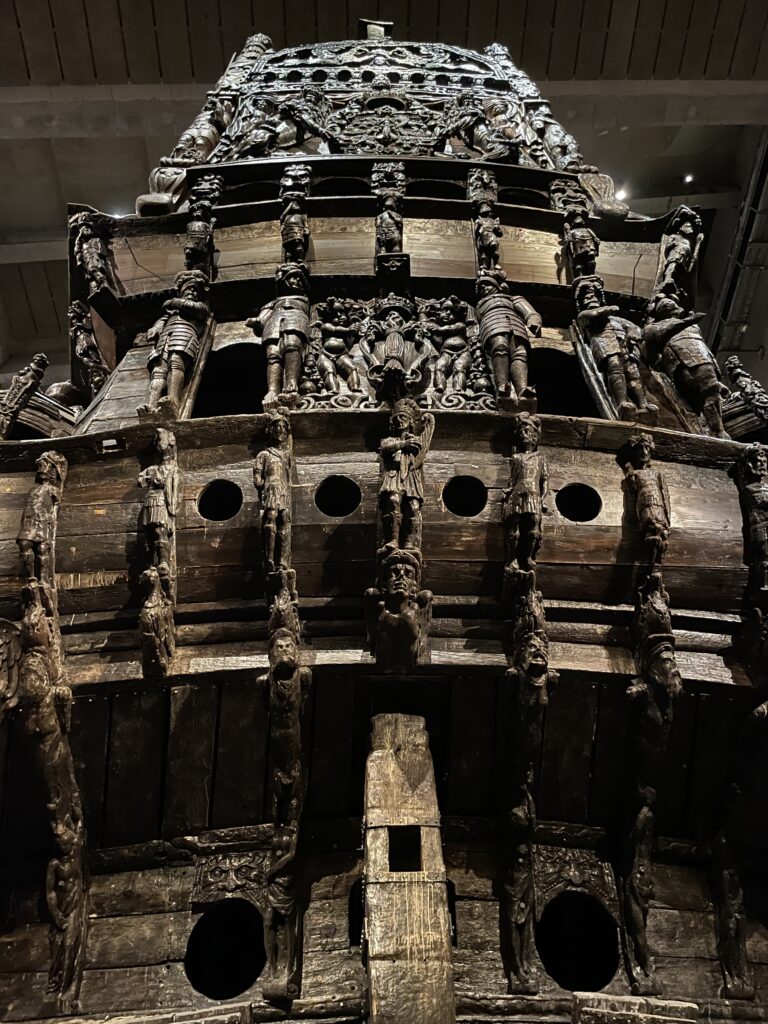 No museum I've been to has ever matched the scale and impact of seeing the Vasa up close
This was attributed to ther design being precariously unstable, with too much weight having been put in the upper structure of the hull, with the keel being too thin and shallow for a ship of her size. Problems were recognized before the launch, but the king was eager for the ship to set sail, with no opposition from others aware of her issues in fear of repercussions.
The initial salvage operation began in August 1959. Hydraulic pumps were fitted around the structure, and the pontoons began to rise. It was a meticulous process, with each lift a little less than a meter. This was done in 18 stages. Eventually, the ship was set in shallower waters, where divers could, at a depth of 17 meters (56 feet), prepare the ship for the final lift. The subsequent process involved divers plugging holes where bolts had eroded away, fitting covers over the open gunports, rebuilding the bow and stern to make them watertight, and fastening steel rods across the hull to help hold it together. By and by, the ship breached the shallow waters on April 24th 1961 – giving the modern world a first glimpse of a ship that had not seen the light of day in over 300 years.
How to Get There
The Vasa Museum is located at Galärvarvsvägen 14, on Djurgården island in Stockholm. You can get here by tram, bus, car or local ferry shuttle.
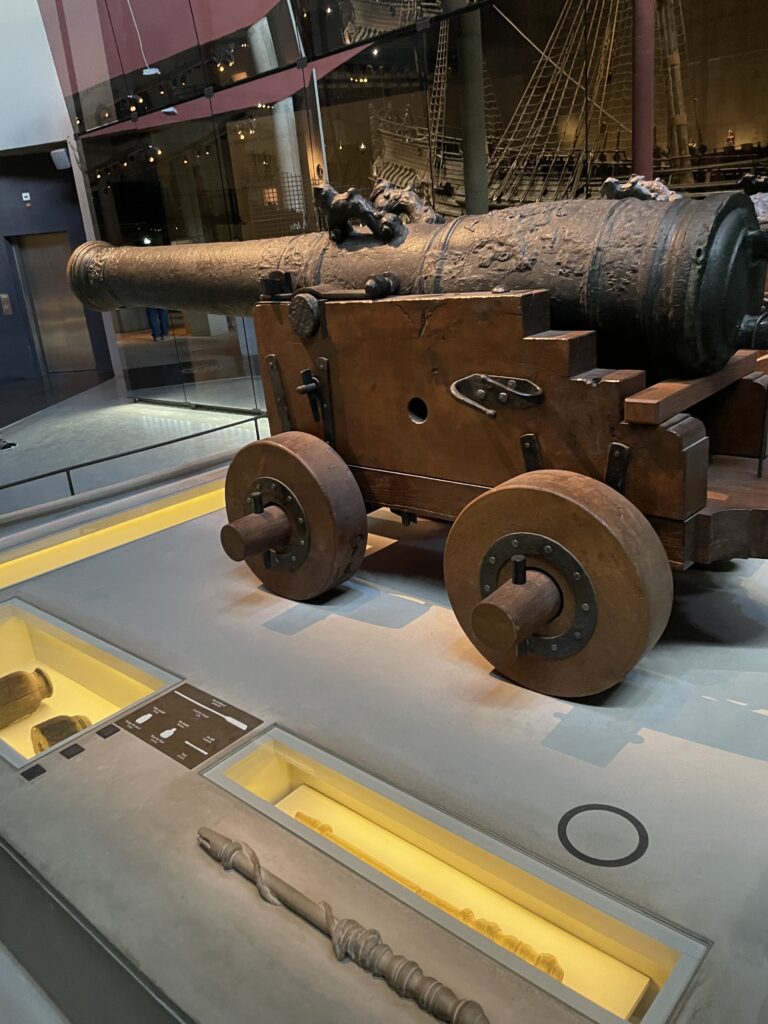 From cannons to combs, the preserved artifacts create a haunting intimacy
Djurgården island contains many other attractions within walking distance that you could combine when visiting the Vasa Museum. These include the Nordic Museum, Gröna Lund, Skansen Open-Air Museum, the ABBA Museum, and the Viking Museum.
The Museum
Initially, I thought the museum might be small, but in fact this place is huge – spanning a grand total of 6 floors, with each one allowing guests a new unique perspective of the Vasa. There are a range of different exhibitions around the ship, ranging from displays of life on board, its historical context and eventual salvage. There is also a film available to watch (available in different languages) which is shown every 20 minutes. A hearing loop is available in the auditorium for screenings.
Numerous exhibitions also display artifacts recovered from the wreck, many still in sterling condition. Most astounding was part of the mast flag that somehow was also preserved enough to be reclaimed. On this note, there are also 3 huge masts on the roof of the museum which show visitors a visual reminder of the height of the ship’s originals masts.
 The Vasa stands as both marvel and mistake, perfectly preserved in time
Audio guides are also available in different languages, to be used by visitors on their own mobile devices – accessible via QR codes within the museum. To help with this, the museum has free Wi-Fi.
Additionally, there are other services onsite too, including a shop and restaurant should you get hungry and/or thirsty during your time there.
Other Things to Keep in Mind
Entrance to the museum is 170SEK ($15.52/€14.76/£12.80), though only card payments are accepted. All visitors who are 18 years old and under get free entrance. Companion tickets for disabled visitors are also given free of charge.
The museum is open 10am-5pm every day, except Wednesday when it is open 10am-8pm. This is the day most museums in the city have extended hours, so keep this in mind when planning your trip, if a late-night visit is more up your street.
 Some examples of the colors used for the paints on the ship's exterior
Daily tours are also offered, which last 25 minutes. Check at the information desk for further details regarding start times.
In terms of accessibility, the museum is wheelchair accessible (there are also currently two wheelchairs available to rent). Elevators can be found on every level of the museum, and accessible toilets are available close to the entrance, in the restaurant and on the 3rd floor.
The museum also has information online regarding peak times for visitors who may become overstimulated or uncomfortable around large crowds. This can be found here.
If you liked this article and would like to support my work, then please consider clicking on one of the buttons above to donate a little to either buy me a coffee or support my business initiative. Your generous support enables me to keep creating new and better content, as well as cover business development costs. Please only do this if you are financially able to do so, as these are challenging times for us all – Thank you!
Leave a Reply