
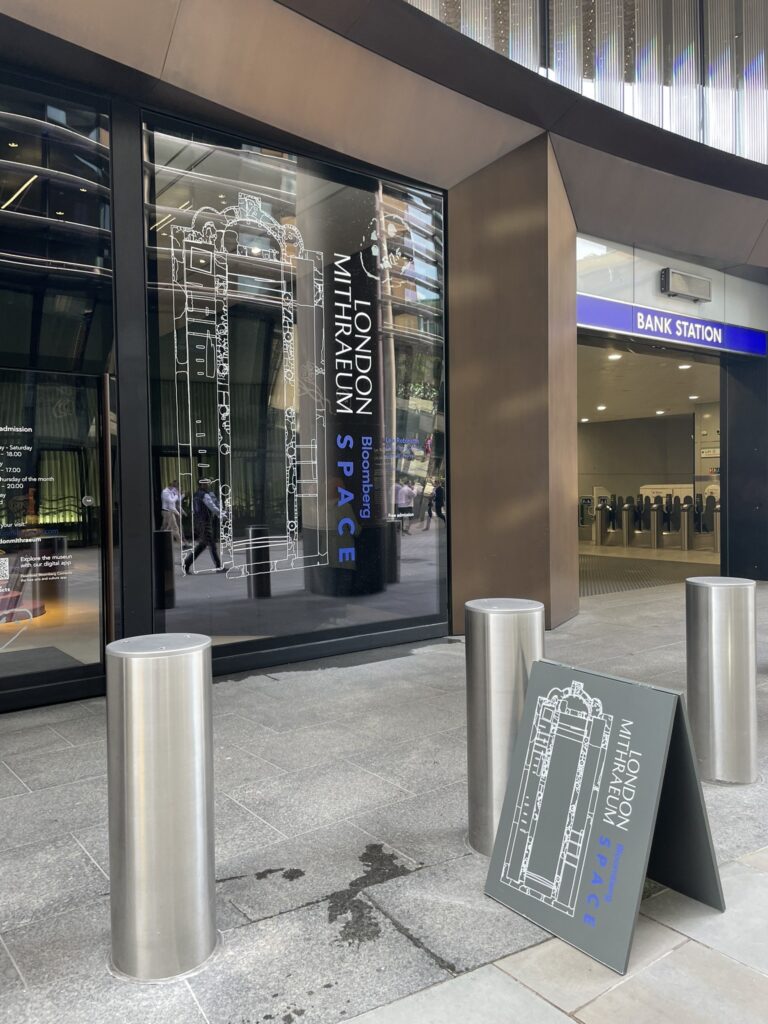
 Don’t let the modern exterior fool you — what’s underneath is pure history.
Large cities are known to contain a lot of secrets. Secret locations that are out of sight for those following the regular tourist trails or even for locals who never explore their local areas. Yet, these secret locations contribute immensely to the makeup of any city and provide visitors with an extra level of richness to their journey.
One such secret I recently unearthed was the London Mithraeum, a Roman-era temple that was discovered in Walbrook, a street in the City of London, during the construction of a building on the site in 1954.
This is one of those sites that you won’t find in many guidebooks, online travel websites, or tourist information booths, which certainly adds to the allure. Indeed, I only became acquainted with the Mithraeum after my archaeologist friend, with whom I was staying with during my time in London, made me aware of it.
Fascinating as it is peculiar, this attraction is worth a 30-or-so-minute visit to anyone looking to dig deeper into London’s history, as well as anyone looking to avoid the usual crowds of visitors that accompany visits to well-known attractions within the city.
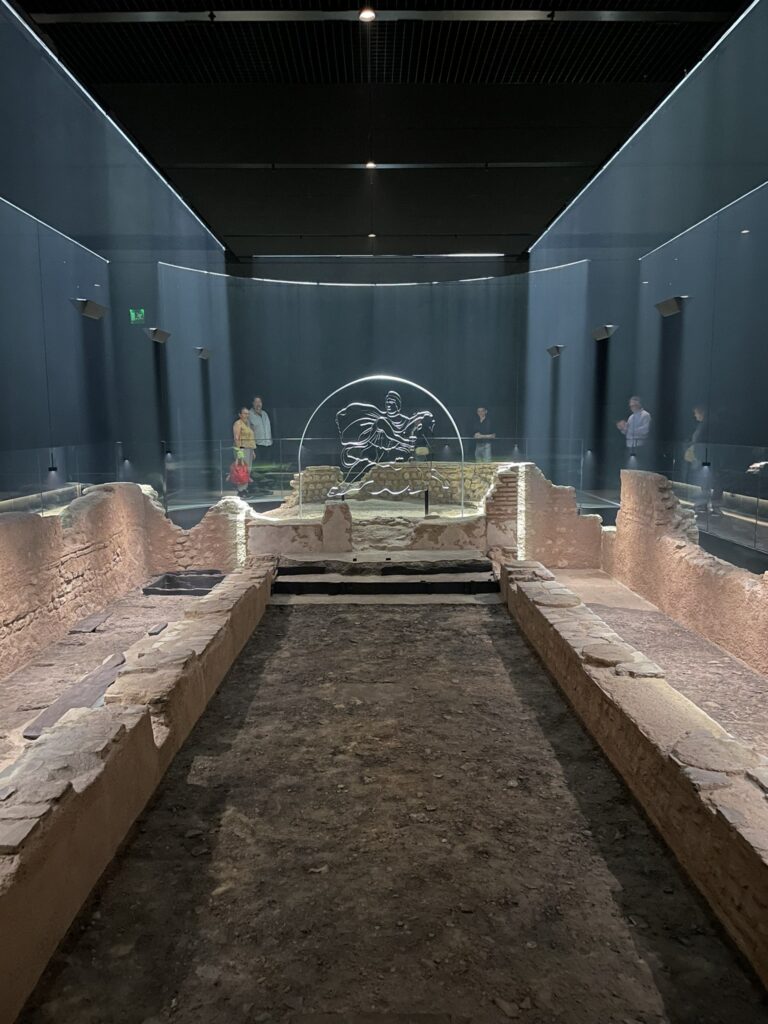 It’s the kind of spot that feels more secretive the more you learn about it. Quiet, ancient, and full of history
Basics
London Mithraeum sits underneath Bloomberg’s European Headquarters on 12 Walbrook Street.
The Temple, which was initially presumed to have been an early Christian church, was built in the mid-3rd century.
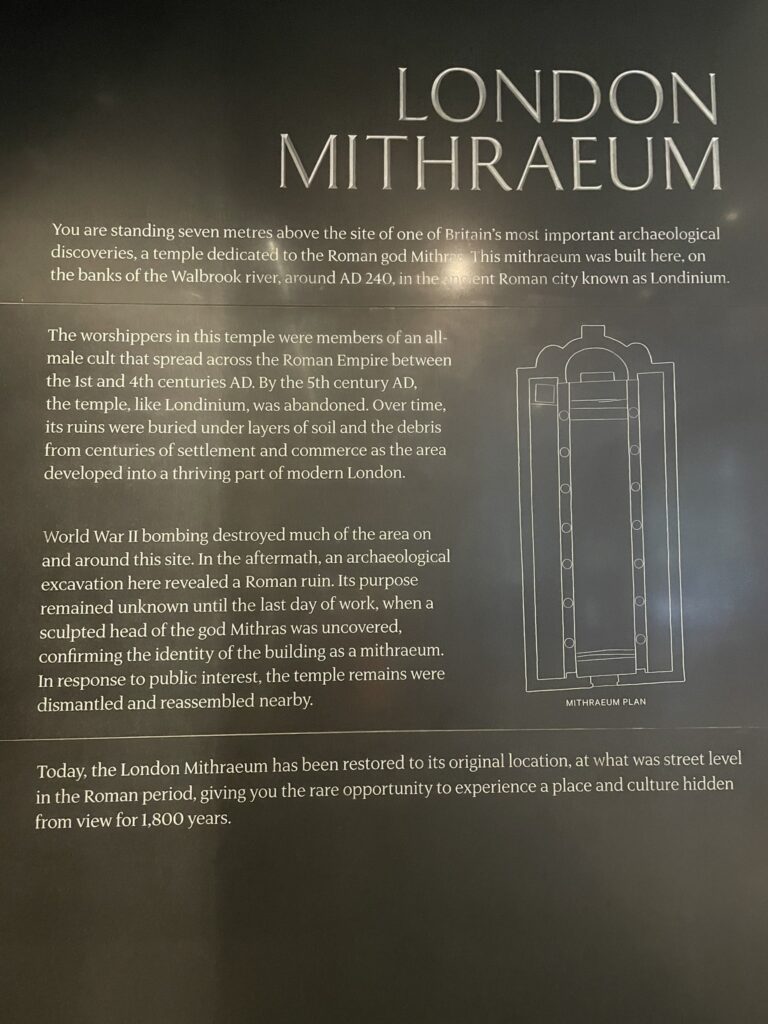
Remaining below street level and measuring 18 meters long, 8 meters wide, and over 2 meters in height, the reconstruction perfectly replicates the ruined remains of the temple found in the 1950s. The research, reinstated design, and scale model mock-ups for the reconstruction took nearly 8 years, followed by another 18 months for the actual reconstruction, which is in almost the same spot as the original location where it was first discovered.
How to Get There
The Mithraeum is currently situated 7 meters (23 feet) below the modern street level as part of an exhibition space beneath the Bloomberg Building on Walbrook Street.
 A perfect spot for a quick history fix — no need to wait in line, just walk in and experience it
Located just next door is Cannon Street Train and Subway Station, which makes visits here very quick and easy as it is a very well-connected station.
Similarly, numerous bus routes also stop along Cannon Street itself, including the 15,17, 735, 736, N15, and N199. Regardless of where you find yourself in the city, you should be able to find a connection easily enough if you don’t happen to be on a direct line.
Overall, London public transport (while not always timely) is extremely fast and painless to navigate. Made even more practical by the fact that all modes of public transport will accept contactless and mobile payments for adult fares.
Facts & History
The word ‘Mithraeum’ might be better understood in English as the ‘Temple of Mithras’ (i.e., the purpose of this structure was to provide a place of worship for followers of the god Mithras).
 Beneath the bustle of the city, this Roman temple holds its own kind of peace
Worship related to Mithras falls under the Greco-Roman practice of ‘Mystery Religions’. Simply put, this means that participation was reserved exclusively for initiates. The main characteristic of these religious schools was the secrecy associated with the specifics of the initiation and the ritual practice, which may not be revealed to outsiders.
The current site is a faithful recreation of the ruin that was discovered in 1954 by renowned archaeologist Professor W.F. Grimes during the excavations for new construction carried out in the wake of the Blitz that took place in 1941.
The temple was subsequently dismantled and moved to a new site a mere 100 meters away at Temple Court, Queen Victoria Street, in 1962. There it remains as an open-air public display, though it drew academic criticism as it was not an accurate reconstruction of the original foundations.
After a lot of to-ing and fro-ing with developers, it was eventually decided that the Mithraeum be moved back to its original location after the Walbrook Square project was purchased by the Bloomberg company in 2010. Though the temple was moved a little west of its original position to preserve parts of the walls that were not uncovered in the initial unearthing, as they are much too fragile to display publicly these days.
 It’s one thing to learn about ancient history; it’s another to actually step into it
So, visitors now have the amazing opportunity to explore the mystical temple that has been restored to capture the romance and intrigue of the Roman cult of Mithras, who used to meet on the site.
The Mithraeum
First up, it’s worth noting that the Temple of Mithras is a multisensory experience, which, personally, is my favorite kind of attraction. It challenges your brain to engage in ways suited to your own learning style and aims to keep everyone present engrossed.
Visits to the museum are self-guided and take no more than 1 hour maximum. Tickets are completely free, though you will have to reserve a time slot on your chosen day before arrival, as spaces are limited to 35 people maximum at any given time. If this is a last-minute decision, however, the staff allowed some people to enter by booking the ticket on the spot when I arrived, though this will obviously depend on the current availability.
Upon entering, you will be ushered to the reception desk, where you will have your ticket checked. Afterwards, you are free to begin your journey through the ages. The ground-floor area behind the reception contains the Bloomberg SPACE. This area highlights a range of modern art projects that creatively interact with the site’s ancient history, offering novel interpretations and fresh viewpoints on its rich archaeological past. The exhibits are rotated every 6 months or so.
 The lighting effects and soundscapes made me feel like I was walking in the footsteps of ancient Romans
Also, on this floor, you will find the artifact display, found just before descending the staircase. The exhibit case comes from relics recovered during excavations carried out between 2012 and 2014—one of London’s largest.
These digs revealed significant new insights into the city’s Roman past, and over 14,000 artifacts were unearthed. These included 63,000 fragmented pieces of pottery and approximately 3 tons of animal remains, all of which shed light on aspects of then-daily life like trade, diet, and industry.
Each item discovered has its own narrative and offers visitors a glimpse into daily life in Londinium (the capital of Roman Britain), illustrating how people interacted with, valued, and discarded these objects.
 It’s one thing to see history, but this place lets you feel it with all your senses
Once you’ve had your fill here, you will head downstairs into a dimly lit room with numerous translucent molds of artifacts on top of interactive screens. This is the penultimate room, before the temple itself, and you are welcome to spend as little time or as long as you like here; however, you will have to wait at designated intervals for groups to leave and enter the temple. The entry times will be clearly called out by the staff on the floor.
I love digging a little deeper than what is visually available when it comes to ancient history, so this is the perfect opportunity to take advantage of it. The screens have several drop-down options that allow you to read about different aspects of the Mithraeum, Ancient Roman religion and mythology, and life in Londinium back then (amongst other aspects).
When the time comes, you will be escorted through to the centerpiece of this visit. Once inside, you will be prompted to spread yourselves out along the rectangular walkway, and the staff member on-duty will give a brief introduction to the Mithraeum and how the interactive portion will work. Then, the lights darken, and the sounds of 2000 years ago begin to trickle through the speakers. Haze, light, the sound of footsteps, chanting, and secret whispers will transport you back to London 240 AD. It’s truly incredible how they manage to transport you back in time and make you feel as though you’re fully immersed in that era, especially given how little of the temple remains today.
 The temple might be small, but it packs a lot of history into its quiet corners
Once the immersive display is over, guests can explore the walkway to see the temple from all angles and take as many pictures as they like. Once content, you will head back the way you came to exit. You are also free to check for anything you missed in the previous rooms before leaving, should you wish.
So, why should you visit? Because the London Mithraeum is a captivating destination that offers a unique look at London’s ancient past, It’s a perfect escape from the city’s usual tourist spots, providing a rich, immersive experience for those willing to seek out its secrets. Whether you’re a history buff or just curious about London’s hidden gems, the Mithraeum is well worth a visit.
Other Things to Keep in Mind
It is important to note that the experience does not permit suitcases, large rucksacks or bikes onsite. Flash photography and videoing are also prohibited inside the temple.
There are various accessible options and implementations available for disabled guests. A full list of them can be found here (including a contact email should you require further information).
Regarding sensory sensitivities in particular, the operators make it clear in advance that the temple viewing experience has low light levels and includes lighting effects, mist, and sound.
If you liked this article and would like to support my work, then please consider clicking on one of the buttons above to donate a little to either buy me a coffee or support my business initiative. Your generous support enables me to keep creating new and better content, as well as cover business development costs. Please only do this if you are financially able to do so, as these are challenging times for us all – Thank you!
Leave a Reply