
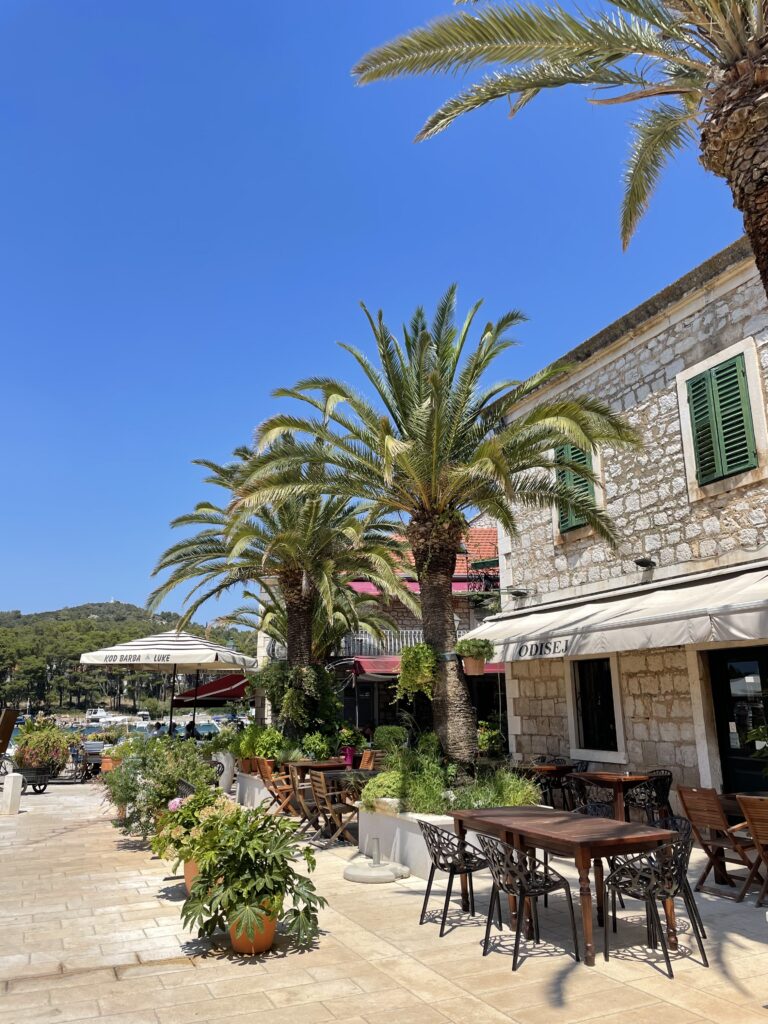
 Cafè culture is strong here - and with good reason, the entire town makes for the perfect outdoor eating/drinking spot
If you happen to find yourself on the idyllic Croatian island of Hvar, then you might want to consider getting out of the main town to see some other sights (and spend less money). So, if that’s the case, then the lovely little northern town of Stari Grad is a great option for visitors. Easily connected and accessible from the main town, and sizeable enough to navigate around – it makes for the ideal trip away for an afternoon. There are many transparent turquoise beaches, historical buildings, laidback cafes and fancy eateries to explore during your stay.
Basics
Stari Grad really is a world away from the glitz of Hvar Town. The town, listed under the more general ‘Stari Grad Plain’, has been a UNESCO World Heritage site since 2008. This inclusion is mainly due to the original agricultural activity of field division, mainly centring on grapes and olives, which has been maintained since Greek times to the present day. Stari Grad was first colonized by Greek settlers coming from the Ionian Island of Paros in the 4th century BCE.
Since then, the town has been governed by various historical administrations; for example – the Romans, the Narentines, and the Venetians. Stari Grad’s current appearance is largely based around its Venetian days, much like the rest of Dalmatia – offering guests an insight into its former past.
 There are plenty of lush green places to visit in the town too!
Recommended Length of Stay
I went for a day trip and felt it was enough time to see a lot of what this gorgeous little town had to offer. However, accommodation options are available should you decide to take things a little slower and spend some more time here.
How to Get There
Once on the island, chances are you will find yourself in Hvar town – where the main port is. The best (and cheapest) way to get to Stari Grad from Hvar town by bus. This is perhaps the islands island’s most well established route and runs at semi-regular intervals with a total journey time of around 30 minutes. The latest timetable, plus pricing can be found here. Alternatively, the schedule is also posted on the wall beside the bus terminal.
The bus terminal is located just to the side of Konzum supermarket, just off of the main square. Hvar Town is small, so you won’t have to walk far to reach the bus terminal.
Car rental and taxis are also options, but with the exorbitant costs found within Hvar Town, I would advise against this.
 The Fortress of Petar Hektorović is a must-see for anyone visiting
Things to do
Stari Grad packs a punch for the size of the place, though I do possess a natural bias for quant little seaside towns in general. There are several attractions worth visiting, as well as some remarkable sights (both natural and man-made).
- Fortress of Petar Hektorović
Also known as Tvralj Castle, this was by far my favourite spot within the town, and one of my top 5 favourite attractions in all of Croatia thus far! The once summer residence of Croatia’s prized poet Petar Hektorović in his hometown of Stari Grad, the estate now acts as a museum of sorts.
 The view out over the Fortress of Petar Hektorović
The castle’s most prominent feature is its fishpond surrounded by a stone porch, teeming with mullet, and with a dovecot rising above it. The fishpond is thought to be as old as the rest of the residence (15th century) and likely originated from an ancient pool. Behind this lies an expanse of greenery; a meticulously tended garden with no shortage of brightly coloured plants. This garden dates to Petar’s time, with flowers being known to have been sent to him by other poet acquaintances.
- Churches of Stari Grad
Stari Grad has an impressive number of churches, the best-known being St. Stephen’s Church -a baroque-styled church whose construction began in 1605, with a significant bell tower added later, located on the square bearing the same name. Once Hvar Island’s first cathedral, the area encompassing the church and square is the most important public space in town. In the days of the former, this is where verdicts were pronounced, and deals were struck.
Not far away is St. Roch’s Church – located in the same open square as Hektorović’s Tvrdalj. St. Roch is the patron saint of this small town. The building itself was completed in the 16th century, with its bell gable added later in 1783. More recently, a mosaic floor of a Roman bathhouse was discovered, which was confirmed by a carved inscription.
 If you have the time, then take a wander through the winding streets and back alleys - they are full of surprises!
St. Lucy’s, St. Jerome’s, St. Nicholas’, and St. John’s Churches are all also located within the town and with the option to explore these too if you want to delve a little deeper into the town’s religious history.
- Explore the Venetian Streets of the Old Town
Visits don’t always have to be attraction based, sometimes it’s as easy as sauntering through winding alleyways to see what you come across. And Stari Grad is a wonderful place to do this. The Venetian alleys offer a lot of secrets if you take your time and let it all soak in. Rich Venetian architecture, archaeological fancies, local handicrafts, and a bunch of cheap eats are just some of the things lying concealed within the laneways. It is also perfect for a relaxed stroll in the afternoon when the hustle and bustle dies down to a trickle as people head home for the daily siesta.
Also, be sure to look for Škor Square while traversing the town. There are many squares to be found, but this is perhaps the most photo-worthy of them all. It also makes for the perfect spot to sit back and watch the world go by!
 House & Mausoleum of Don Šime Ljubić features some of the best architectural work in the town
The seafront promenade that intersects the town was also a personal highlight of mine. A leisurely stroll along the palm-lined boulevards on a bright sunny day is sure to soothe your soul. Like the rest of the town, it is encased with well-maintained Venetian Renaissance structures, Italian-styled osterias and restaurants, subdued souvenir stands, and, best of all, ice-cream stores! Be sure to try the lavender flavoured ice-cream – you won’t regret it! Hvar is a major exporter of lavender, so you can guarantee any lavender products you encounter are fresh from the nearby fields!
- House & Mausoleum of Don Šime Ljubić
Think of this as more of a photo-op than an attraction, as you aren’t able to enter. But this is undoubtedly the most striking building within the town. You won’t be able to miss it walking along the waterfront with its brightly coloured pink facade.
Šime Ljubić was an eminent archaeologist, theologian, and historian, best remembered as one of the founders of the Croatian Academy of Sciences and Arts. He commissioned this grand villa in 1887 The villa is adorned with a selection of terracotta sculptures, allegories of muses and historical deities. After his passing, Šime Ljubić was then buried in the monumental mausoleum on the west side of the house, which still stands tall today.
 The soothing waters of Lanterna Beach
- Oslic and Lanterna Beaches
If you need to cool off from the sun, then you won’t have far to walk before reaching either of the 2 main beaches; Oslic and Lanterna – located on the north and south sides of the inlet, respectively.
As with most of the waters I came across on the Croatian coast, the water here could easily be made of emeralds, the colours are out of this world! Another thing you should be aware of about Croatian beaches is that most (at least the ones I encountered) are made of rock and not sand, so it is best not to walk barefoot wherever possible.
Nonetheless, they do get busy during afternoons, so you might have to walk a little to find an ideal spot to settle yourself down on.
There is not much in terms of things to do or buy (save for a couple of small stalls), so be sure to pack some supplies if you plan to spend a while here, so you can sit back and be carried away by the calming sea breeze.
 Looking towards the the church of St. Stephen from the plaza
- The Dominican Monastery of St. Peter Martyr
Another of the town’s religious institutions, this one is far larger than the rest and was established in 1482. Following the historical run of invasions and subsequent fortifications, the structure was eventually rebuilt into what we see today.
Visits are permitted from May through to October, which corresponds with the tourist seasons.
The interior contains a small museum housing numerous works of art, the most notable being the large painted Renaissance crucifix located by the church’s main altar. Also of interest, the museum contains the oldest Greek inscriptions ever found in modern-day Croatia, dating all the way back to the time of the first settlers to the island town.
Croatian poet Petar Hektorović (as well as his mother) are also entombed here. Some of his verses are carved into the stone above the main entrance doors to the church.
 The is still plenty of gorgeous Venetian architecture to be found through the palm-laden streets
- Visit the Stari Grad Plain
Admittedly, I didn’t find out about this until after I returned to Hvar Town – so, it remains on my bucketlist for the time being. Nonetheless, the Stari Grad Plain which UNESCO helped put on the map is visitable by tourists.
The Plain is a cultural landscape which has been shaped by humans for millennia. Its basic foundations were determined by the first Greeks who arrived on the island. They went on to divide the land into rectangular plots bounded by stone walls, and major paths intersecting it both horizontally and vertically at regular intervals. The plot division system of the Stari Grad Plain represents one of the masterpieces of Greek culture in the Mediterranean. Not too much has changed since those days, and those same plots are still being cultivated by today’s residents on the island.
I learned from a friend that the best way to visit here is by renting a bike and cycling along the paths. Exploring the plains by bicycle also enables you to cover a greater area without suffering too much wrath from the heat of the sun and, as a bonus, allows you to get off and check out the ancient ruins at any point along the way. Rental bikes can be hired in the town itself. Though, if you would prefer to have some added historical background explained, then you can arrange a guided tour which starts in Stari Grad.
 The fortress was well and truly the highlight of this visit
Other Things to Keep in Mind
In keeping up with tradition, Stari Grad observes siesta time. Typically, you will find a lot of the town’s attractions and other businesses close their doors between 1pm and 2pm, and subsequently reopen them around 4 or 5pm. For this reason, I recommend you take an early bus to get the full experience here.
If you liked this article and would like to support my work, then please consider clicking on one of the buttons above to donate a little to either buy me a coffee or support my business initiative. Your generous support enables me to keep creating new and better content, as well as cover business development costs. Please only do this if you are financially able to do so, as these are challenging times for us all – Thank you!
Leave a Reply